Add: NYaqian Road No128 Yaqian Town Xiaoshan Hangzhou Zhe Jiang China.
Tel: 0086-0571-82602080
Fax: 0086-0571- 82758132
E-mail: [email protected]
Article Directory
When a weaving mill sits down to order polyester fully drawn yarn (FDY), the conversation rarely stays generic. The production team usually has a specific number in mind: a tenacity target for a warp-knitted fabric, a shrinkage limit for a garment that will be heat-set, or a trilobal cross-section that gives a curtain a particular sheen. The reason is simple. FDY controls how the fabric behaves on the machine and in the customer's hands afterwards. A yarn that is "close enough" on paper can still create hours of trouble on a warping creel or in the dyehouse.
The useful way to think about custom FDY yarn solutions is as an engineering exercise. A custom solution is not a mysterious product. It is the combination of polymer quality, spin-draw settings, finish application, and routine testing that turns a standard fully drawn yarn into a repeatable input for a specific textile process. For manufacturers, the payoff is concrete: fewer trial runs, fewer off-shade batches, higher machine efficiency, and a finished fabric that matches the buyer's performance claims.
FDY is produced by melt-spinning polyester and drawing the filaments in-line to orient the polymer chains. That drawing stage is where the specification is actually set. A supplier can adjust several parameters, usually within defined limits, to fit the end application.
Total denier and filament count determine the hand feel, coverage, and dye appearance of the fabric. A 75D/36F yarn behaves very differently from a 75D/72F version. Lower per-filament denier (dpf) gives a finer, softer touch for lightweight apparel; higher dpf adds body and abrasion resistance for home textiles and industrial uses. The choice also affects warp-knitting efficiency and how uniformly the yarn absorbs dye.
Tenacity, measured in cN/dtex, defines how much stress the yarn can survive during weaving, knitting, and end use. High-tenacity FDY grades are specified for sewing thread, webbing, automotive textiles, and other applications where strength is the deciding factor. Elongation at break must sit in a window that balances processability with fabric stability. Shrinkage, checked as boiling water shrinkage or dry heat shrinkage, becomes critical when the fabric will be heat-set or dyed at elevated temperature. A low-shrinkage FDY keeps warp-knitted curtains and technical fabrics dimensionally stable.
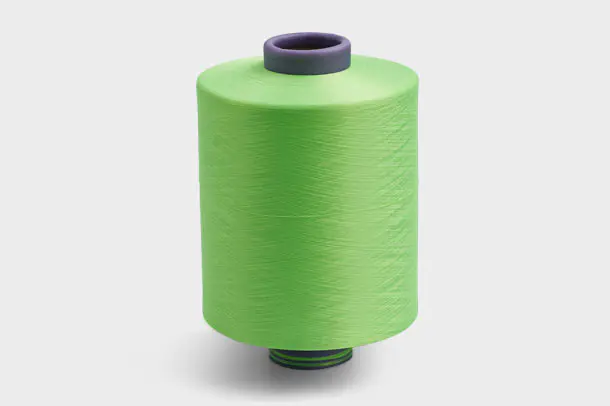
Bright, semi-dull, and full-dull finishes change the optical character of the finished fabric. Trilobal bright FDY is a well-documented route to a silk-like luster in fashion and decorative textiles. Color can follow two paths: conventional exhaust dyeing after weaving, or dope-dyed FDY where the pigment is added before spinning. Dope-dyed yarn reduces water consumption and dramatically improves color fastness, but the shade range must be planned before production. For a manufacturer whose products demand repeatable color, the polyester FDY series from an integrated producer is worth examining early in the sourcing process.
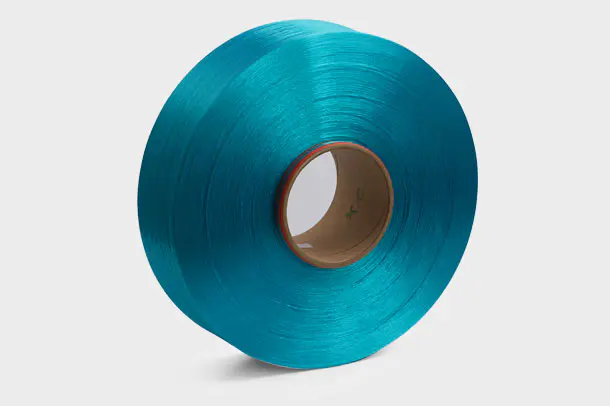 China Wholesale Polyester FDY Yarns Manufacturers, FactoryAs a China polyester FDY Yarns manufacturers and polyester FDY factory, Zhejiang Hengyuan Chemical Fiber Group Co.,Ltd. provide wholesale...View Product →
| Parameter | Typical Range | Main Impact |
|---|---|---|
| Denier | 30D to 300D | Fabric weight, coverage, machine settings |
| Filament count | 12F to 144F | Hand feel, softness, dye appearance |
| Tenacity | 3.5 to 6.5 cN/dtex | Weaving efficiency, end-use strength |
| Elongation at break | 20% to 40% | Processability, dimensional stability |
| Boiling water shrinkage | 3% to 8% | Heat-setting behavior, fabric stability |
| Luster / cross-section | Bright, semi-dull, trilobal | Optical effect, shade appearance |
| Color route | Conventional or dope-dyed | Fastness, water usage, shade control |
Because these parameters interact, changing one usually forces a rebalance of the others. A high-tenacity grade tends to show lower elongation and a higher initial modulus. The real test of a custom FDY program is whether the supplier can hold the full specification window across production lots, not just match a single number on a datasheet.
Custom FDY is not assembled from stock. It is made by controlling each stage of the continuous spinning and drawing process.
The process begins with polyester chips, which are melted, extruded through spinnerets, and quenched into filaments. The filaments pass over godet rolls running at different speeds; the speed difference creates the draw ratio that orients the polymer chains. A higher draw ratio raises tenacity and lowers elongation, while a milder draw produces a softer, more extensible yarn. Godet temperature and quenching conditions also influence crystallinity, which is why two FDY yarns with the same denier can dye differently or run unevenly on a high-speed machine.
The practical lesson for a textile manufacturer is that the drawing zone determines consistency. Suppliers with their own melt-spinning and drawing lines can control these variables directly. That is why the manufacturing setup of a filament producer, including the condition of its spinning machines and the way it records process data, should be part of any supplier audit before a custom specification is approved.
In practice, most custom FDY programs trace back to the partially oriented yarn that feeds the draw line. When a company produces its own polyester POY series in the same plant, the FDY specification is easier to stabilize because raw material quality does not change with each delivery. Buyers should always ask whether the POY source is internal or external. The answer separates integrated manufacturers from traders.
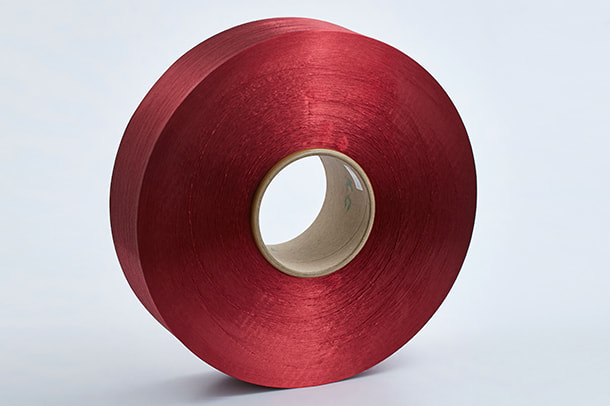 China Wholesale Polyester POY Yarns Manufacturers, SuppliersZhejiang Hengyuan Chemical Fiber Group Co.,Ltd is China polyester POY Yarns manufacturers and polyester POY Yarn suppliers, factory offer...View Product →
A specification is only useful if it can be verified. Reliable FDY production includes routine testing of denier, tenacity, elongation, shrinkage, oil content, and interlacing level on each batch, with records available to the buyer. Statistical process control matters because occasional spot checks cannot protect a mill running hundreds of machines on the same yarn. Automated testing and color measurement create the kind of data trail that shifts the quality burden from the buyer's incoming inspection to the supplier's production floor. A producer that maintains a dedicated research and development center is more likely to have the equipment and discipline to support this level of control.
Fully drawn yarn appears across many textile segments, but each segment rewards a different configuration.
Manufacturers frequently ask whether to specify FDY or draw-textured yarn (DTY). The answer depends on the fabric construction and the end use. FDY is smooth, straight, and strong, with excellent dimensional stability, making it the natural choice for warp knitting, weaving, linings, and technical fabrics. DTY is crimped and bulky, with more elasticity and a fuller hand, which suits knitwear, sportswear, and upholstery where softness and stretch are priorities. For a manufacturer serving several markets, the correct choice is never "always FDY" or "always DTY." The polyester DTY series is the logical complement when a fabric requires bulk instead of flatness.
 Wholesale Polyester DTY Yarns Suppliers, China DTY CompanyZhejiang Hengyuan Chemical Fiber Group Co.,Ltd is China polyester DTY yarns suppliers and polyester DTY company, you can find wholesale p...View Product →
In apparel linings and outerwear shells, a semi-dull FDY with controlled shrinkage keeps the fabric smooth through dyeing and heat setting. In home textiles such as curtains, sheers, and table linens, trilobal bright FDY delivers the drape and sheen that polyester is known for without extra chemical finishing. Automotive and technical fabrics lean toward high-tenacity FDY with lower elongation, because seat covers and safety-related textiles face continuous stress and must hold their dimensions under temperature changes. In industrial sewing thread, tightly controlled denier and tenacity reduce seam breakage on high-speed sewing machines.
A supplier's product range matters at this point. A manufacturer offering FDY, DTY, POY, and specialty yarns under one roof is better positioned to recommend a transition between grades instead of forcing a square peg into a round hole. If your development team is testing a new construction, the ability to request small trial quantities of a modified specification is worth more than a low price on an off-the-shelf yarn that is merely close to what the project needs.
Ordering custom FDY is not the same as buying a commodity yarn. The risks concentrate in a handful of places.
Most of these risks shrink when the supplier publishes technical parameters and explains its production process openly. The best FDY partners treat an order as a development project rather than a spot sale, and they document the variables that affect your fabric.
The final question is not whether a supplier can "do" FDY. It is whether they can hold a custom specification across months of production and give your team the technical support needed to succeed. Integrated production, documented quality control, and a product range wide enough to offer options when a fabric specification changes are the practical markers of that capability.
A supplier that draws its own FDY and understands how POY quality affects the finished yarn is more likely to catch a problem before it reaches your factory. A supplier that will run a trial of a modified denier or a custom luster, then back it up with test data, is worth more over the life of a product line than a low-priced intermediary. For manufacturers planning new fabric programs, reviewing the FDY product selection guide and discussing the application with the producer's technical team is the fastest route from a generic purchase to a genuine custom solution.

Zhejiang Hengyuan Chemical Fiber Group Co.,Ltd. is a professional China polyester filament yarns manufacturers and polyester color yarn suppliers, Established in 2006 ,located in YaQianTown Xiaoshan Hangzhou – One of the Center of polyester yarn Industry in China.

Products
Contact info
Copyright © Zhejiang Hengyuan Chemical Fiber Group Co.,Ltd. All rights reserved