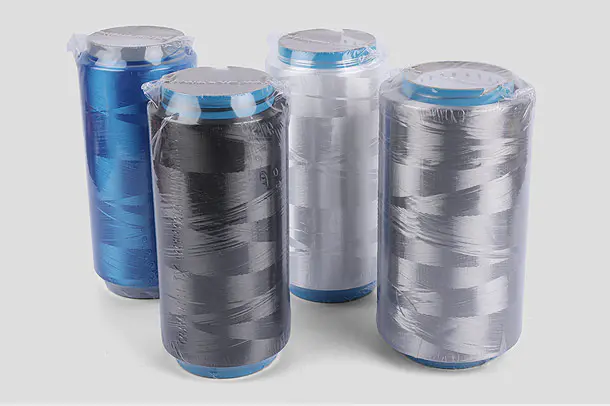
Ultra High Molecular Weight Polyethylene Yarn Manufacturers

POY Yarn Series FDY Yarn Series DTY Yarn Series Blanket Yarn Series Polyester Carpet and Rug Yarn Ultra high molecular weight polyethylene Yarn Series Functional Yarn Series

ultra high molecular weight polyethylene

PRODUCT DETAILS

  • Parameters
  • Color Card
  • Quipment
  • Application

ITEM

SPEC

SD

TBR

Ultra high molecular weight polyethylene Series 50D · ·
75D · ·
100D · ·
125D · ·
150D · ·
200D · ·
250D · ·
300D · ·
350D · ·
400D · ·
600D · ·
800D/240F/480F · ·
1200D · ·
1600D/480F/960F · ·
1200D · ·
  • Exceptional Strength-to-Weight Ratio: UHMWPE yarn delivers tensile strength per unit mass significantly exceeding aramid fibers and steel wire of equivalent cross-section, enabling lightweight structural and protective designs without strength compromise.
  • Low Elongation at Break: Elongation at break in the range of 2.5–4.5% provides minimal energy absorption under load, producing responsive, low-stretch behavior in rope, sling, and rigging applications where precise load control is required.
  • Near-Zero Moisture Absorption: Moisture regain below 0.1% means UHMWPE yarn retains its mechanical properties in wet, humid, and submerged environments — a critical advantage over aramid and natural fiber alternatives in marine and water-contact applications.
  • Chemical Resistance: Resistance to a broad range of acids, alkalis, and organic solvents makes UHMWPE yarn suitable for use in corrosive industrial, chemical handling, and seawater environments where organic polymer degradation is a service risk.
  • Cut and Abrasion Resistance: The high molecular chain alignment and crystallinity of UHMWPE fiber provide resistance to cutting and abrasion, supporting its use in personal protective gloves, protective sleeves, and cut-resistant apparel applications certified to EN 388 and ANSI/ISEA 105 standards.
  • Floats on Water: A density below 1.0 g/cm³ (approximately 0.97 g/cm³) means UHMWPE rope and textile products float on the water surface — a functional advantage in marine, offshore, and aquaculture applications compared to polyester, nylon, and wire rope alternatives.
  • UV and Radiation Resistance: UHMWPE exhibits resistance to UV radiation and gamma radiation compared to many organic polymer fibers, extending service life in outdoor and radiation-exposed environments.

Product Specifications & Technical Parameters

Key Mechanical and Physical Parameters

Parameter Typical Range Unit
Molecular Weight 3.5 – 7.5 million g/mol
Linear Density Range 44 – 1,760 dtex
Filament Count 60 – 1,200 f
Tenacity 28 – 40 g/d (cN/dtex × 0.9)
Tensile Modulus 900 – 1,500 cN/dtex
Elongation at Break 2.5 – 4.5 %
Density 0.97 g/cm³
Moisture Regain < 0.1 %
Melting Point 144 – 152 °C
UV Resistance High
Chemical Resistance Acids, alkalis, solvents

Standard Linear Density Grades

Grade Linear Density (dtex) Filament Count Primary Application
Fine Grade 44 – 110 60 – 120 Cut-resistant gloves, medical textiles, composites
Medium Grade 220 – 440 120 – 480 Ropes, slings, protective apparel, ballistic panels
Heavy Grade 880 – 1,760 480 – 1,200 Marine ropes, mooring lines, offshore lifting slings

Comparison: UHMWPE vs Aramid vs Carbon Fiber

Property UHMWPE Aramid (e.g. Kevlar) Carbon Fiber (standard)
Density (g/cm³) 0.97 1.44 1.75
Tenacity (g/d) 28 – 40 20 – 28 18 – 25 (equiv.)
Elongation at Break (%) 2.5 – 4.5 2.4 – 3.6 1.5 – 2.0
Tensile Modulus (GPa) 100 – 170 70 – 125 230 – 400
Moisture Absorption < 0.1% 3.5 – 7% < 0.1%
Melting / Degradation Point 144 – 152°C ~500°C (decomposition) > 3,000°C (oxidation ~400°C)
Chemical Resistance Excellent Moderate (UV sensitive) Good (oxidative acids)
Floats on Water Yes No No
Cut Resistance High High Moderate (brittle)
Composite Adhesion (untreated) Poor Moderate Good (sized fiber)
Primary Applications Ropes, armor, PPE, marine Armor, aerospace, tires Aerospace, structural composites
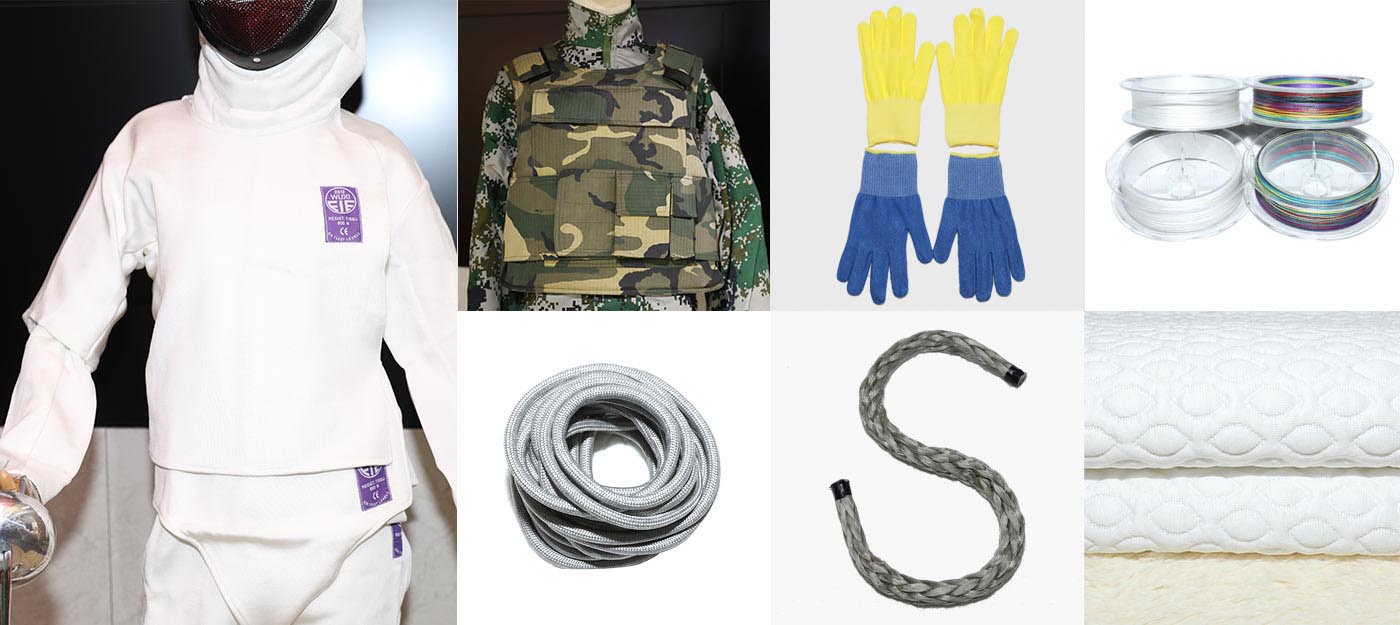
Application Scenarios

Aquaculture and Fishing

  • Fish Cage Netting: UHMWPE net yarn for offshore aquaculture cage systems, where high tensile strength, seawater resistance, and low net weight reduce installation and handling load on cage structures.
  • Fishing Lines and Nets: Braided UHMWPE fishing line (superline) for sport and commercial fishing, where low diameter-to-strength ratio, zero stretch, and buoyancy combine for high sensitivity and line control.
  • Trawl and Purse Seine Nets: Heavy-grade UHMWPE yarn in commercial fishing net constructions for reduced net weight and improved fuel efficiency in trawling operations.

Defense and Aerospace

  • Lightweight structural cables and tethers for UAV and aerospace applications requiring high strength-to-weight with dimensional stability.
  • Parachute suspension lines and deployment systems where low weight and high reliability are concurrent requirements.
  • Perimeter security fencing and anti-intrusion barrier systems using UHMWPE woven or braided panels resistant to cutting tools.

Processing Guidelines & Handling Notes

Storage Conditions

  • Store UHMWPE yarn in a clean, dry environment away from direct UV light; although UHMWPE has good UV resistance relative to many polymers, prolonged direct sunlight exposure causes gradual surface photodegradation that reduces tenacity over extended storage periods.
  • Keep away from heat sources and open flames; UHMWPE has a relatively low melting point (144–152°C) and begins to soften well below this temperature under sustained load. Yarn stored in proximity to heating equipment may undergo irreversible property loss.
  • Avoid contact with hydrocarbon solvents (mineral spirits, diesel, ketones) in concentrated form during storage; these solvents can cause surface swelling in UHMWPE at elevated temperatures, reducing mechanical properties.
  • Store on original reels or bobbins to prevent uncontrolled yarn tension that can introduce elongation set in the yarn structure prior to use.

Processing and Fabrication Notes

  • UHMWPE yarn cannot be heat-bonded or thermally fused using conventional textile heat-setting processes due to its low melting point; joining and termination must use mechanical means (knots, splices, swaged fittings) or specialized low-temperature adhesive systems.
  • Knot efficiency in UHMWPE yarn is lower than in conventional rope fibers due to the low-friction, low-elongation surface; knot breaking load is typically 50–70% of the straight-line breaking load. Spliced terminations are preferred over knotted terminations for load-critical applications.
  • Standard textile cutting tools (scissors, blades) are effective for cutting UHMWPE yarn; however, the cut-resistant properties of the fiber cause rapid dulling of standard blades. Ceramic or hardened cutting tools are recommended for sustained cutting operations on UHMWPE yarn or fabric.
  • For composite lamination, only surface-treated UHMWPE grades with verified surface energy (wettability) values should be used; untreated UHMWPE fiber will delaminate from epoxy or polyester resin matrices under shear loading due to insufficient interfacial adhesion.
  • Friction and abrasion over sharp metal edges generate localized heat sufficient to melt UHMWPE filaments; sheave diameters, fairlead radii, and block dimensions in rope and rigging applications must be sized to maintain contact stress and bending fatigue below fiber degradation thresholds.

Safety and Service Inspection

  • Inspect UHMWPE rope, sling, and lifting textile products regularly for surface filament cuts, abrasion damage, and discoloration; visible filament breakage at the surface indicates internal load-bearing capacity reduction that is not detectable by external diameter measurement alone.
  • UHMWPE lifting slings must be retired from service when surface filament damage, chemical contamination, or heat discoloration is observed; load rating reduction from surface damage is non-linear and cannot be estimated visually with sufficient reliability for continued use in safety-critical lifting.
  • For ballistic and protective applications, UHMWPE panels should be inspected for impact damage before continued use; ballistic panels absorb projectile energy through controlled fiber failure and may not show external damage commensurate with reduced residual protection capability after a strike.

Related Products

POY Yarn Series
POY Yarn Series
FDY Yarn Series
FDY Yarn Series
DTY Yarn Series
DTY Yarn Series
Blanket Yarn Series
Blanket Yarn Series
Polyester Carpet and Rug Yarn
Ultra high molecular weight polyethylene Yarn Series

FEEDBACK