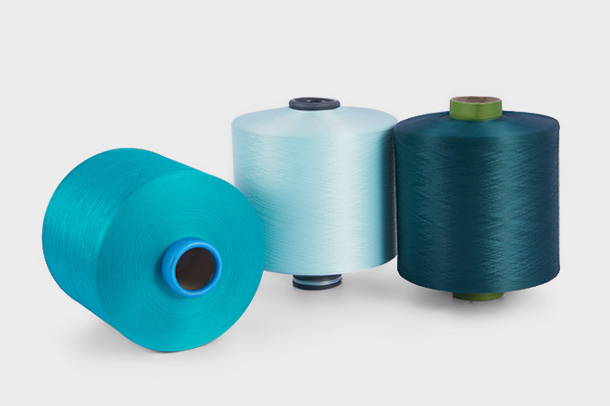
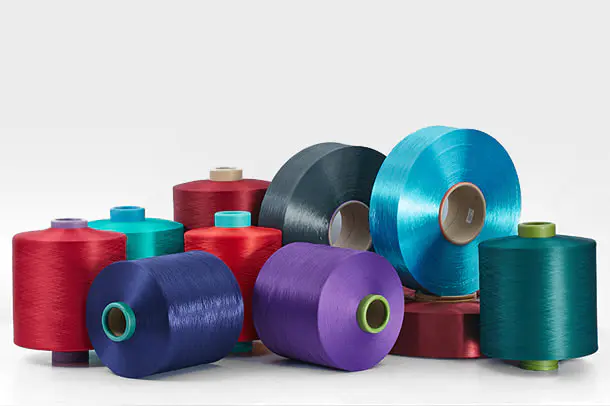
PRODUCT DETAILS
Moisture management yarn is engineered to transport perspiration moisture away from the skin surface through the fabric construction and to the outer surface for evaporation. This wicking function is achieved through capillary action driven by modified filament cross-sections — including trilobal, cross-shaped, hexalobal, or hollow configurations — that increase the surface area and create inter-filament channels for liquid transport along the yarn length. Moisture management yarns are used in sportswear, activewear, base layers, socks, and workwear where thermal comfort under physical activity is a functional requirement. Performance is quantified using AATCC 195 (Liquid Moisture Management Properties) or equivalent standard test methods.
Antimicrobial yarn inhibits the growth of bacteria, fungi, and odor-causing microorganisms on the fabric surface and within the fiber structure. The antimicrobial function is achieved through incorporation of active agents — including silver ions (Ag⁺), zinc oxide nanoparticles, copper compounds, or organic antimicrobial agents such as triclosan alternatives — either blended into the polymer melt prior to extrusion (inherent antimicrobial) or applied to the fiber surface as a durable finish (applied antimicrobial). Inherent antimicrobial yarns retain activity through 50+ wash cycles and are used in medical textiles, sportswear, intimate apparel, socks, and home textiles where microbial growth and odor formation are functional concerns. Performance is tested against ISO 20743, AATCC 100, or JIS L 1902 standards.
| Functional Category | Key Performance Metric | Test Standard | Typical Base Fiber |
|---|---|---|---|
| Moisture Management | MTI ≥ 0.5, wicking rate | AATCC 195 | Polyester, PA, PP |
| Antimicrobial | Bacterial reduction ≥ 99% | ISO 20743, AATCC 100 | Polyester, PA, cotton |
| Flame Retardant | LOI ≥ 28%, afterflame ≤ 2 sec | EN ISO 14116, EN 11612 | Modacrylic, FR viscose, FR polyester, aramid |
| UV Protection | UPF ≥ 50+ | AS/NZS 4399, AATCC 183 | Polyester, PA, cotton |
| Antistatic / Conductive | Surface resistivity < 10⁹ Ω/sq | EN 1149-3, IEC 61340 | Polyester + carbon/steel filament |
| Thermal Regulation (PCM) | Heat storage ≥ 10 J/g | DSC (ISO 11357) | Polyester, PA, acrylic |
| Odor Control | Odor reduction ≥ 80% after 30 washes | ISO 17299, AATCC 212 | Polyester, PA, cotton |
| Far Infrared | FIR emissivity ≥ 80%, 6–14 µm | FTIR emissivity measurement | Polyester, PA |
|
ITEM |
SPEC |
SD |
TBR |
| Functional Yarn Series | 30D/24F | · | · |
| 50D/24F/36F | · | · | |
| 75D/36F | · | · | |
| 90D/36F | · | · | |
| 100D/36F /72F/144F | · | · | |
| 120D/36F | · | · | |
| 150D/48F/72F/96F/144F/288F | · | · | |
| 200D/72F/96F/144F | · | · | |
| 250D/72F/96F /122F/144F | · | · | |
| 300D/72F/96F144/F288F | · | · | |
| 450D/144F/192F/216F/288F/384F/432F/488F | · | · | |
| 500D/144F/192F | · | · | |
| 600D/144F/192F/288F | · | · |
Inherent functional yarn achieves its performance property through the polymer composition itself — either through co-monomer modification during polymer synthesis or through inclusion of functional additives in the polymer melt before fiber extrusion. The functional property is distributed throughout the fiber cross-section and is therefore permanent; it cannot be washed out, abraded off, or removed by chemical processing. Treated functional yarn achieves its function through a chemical or physical treatment applied to the fiber or yarn surface after production — for example, a topical antimicrobial coating, a UV-absorbing finish, or an FR backcoating. Surface treatments may degrade over washing cycles and service life, and their durability must be verified through standardized wash durability testing. For performance-critical applications (medical, PPE, safety-certified), inherently functional yarn is generally preferred over treated yarn to ensure durable, verifiable performance.
Yes. Multiple functional properties can be incorporated into a single yarn through several approaches: blending functional additives in the polymer melt before extrusion (e.g., UV absorber + antimicrobial agent in the same fiber), combining filaments of different functional types within a single yarn bundle (e.g., standard polyester filaments + conductive carbon filaments + FIR ceramic filaments), or applying multiple surface treatments in sequence. The practical limit on multi-function combination is the compatibility of additives (some interact chemically) and the total additive loading level that the polymer matrix can accommodate without compromising fiber mechanical properties. Yarn developers and manufacturers can provide compatibility guidance for specific multi-function combinations relevant to target applications.
Wash durability requirements depend on the application category and the applicable standard. For antimicrobial textiles in apparel applications, ISO 20743 and AATCC 100 typically require activity retention after 10–50 wash cycles depending on the standard version and claim level. For FR protective clothing certified to EN 11612, flame retardant performance must be retained after 50 industrial wash cycles. For UV protection garments certified under AS/NZS 4399, UPF performance is tested after laundering to verify retention. Inherently functional yarns (polymer-incorporated additives) typically perform consistently across all required wash cycles; surface-treated yarns require careful durability testing and may need re-treatment after a defined number of wash cycles in demanding applications.
The primary test method for moisture management performance in finished fabric is AATCC 195 (Liquid Moisture Management Properties of Textile Fabrics), which uses the Moisture Management Tester (MMT) to measure wetting time, absorption rate, maximum wetted radius, spreading speed, and accumulative one-way transport capacity on both the inner (skin-contact) and outer fabric surfaces. Results are combined into the Overall Moisture Management Capacity (OMMC) index and the Moisture Transport Index (MTI). Secondary test methods include AATCC 79 (absorbency/wicking) and vertical wicking tests for directional moisture transport evaluation. For certification-level claims, testing must be conducted on finished fabric after the full dyeing and finishing sequence, as softener application and heat treatment affect wicking channel geometry in modified cross-section yarn.
Functional yarn carries a cost premium over standard yarn that varies by functional type, additive cost, and production complexity. The premium is justified at the product level rather than the yarn level: functional yarn typically enables the elimination or reduction of fabric finishing steps (reducing finishing chemical, energy, and processing costs), supports higher retail price positioning for certified performance products, and reduces warranty and return costs in applications where functional failure has commercial consequences. For FR and antistatic protective workwear, inherently functional yarn is a compliance requirement — not an optional upgrade — and the cost comparison is against the liability and compliance risk of non-certified alternatives rather than against standard yarn cost.
Functional yarn and fabric certifications vary by functional category and target market. For substance safety, OEKO-TEX Standard 100 certifies that yarn and fabric do not contain harmful chemical residues above regulated thresholds — applicable to all functional yarn categories. For specific performance claims: antimicrobial fabrics are tested to ISO 20743 or AATCC 100; FR protective fabrics are certified to EN 11612, EN ISO 14116, or NFPA 2112; antistatic garments to EN 1149-5; UV-protective fabrics to AS/NZS 4399 or EN 13758; and recycled content to GRS (Global Recycled Standard). bluesign certification covers chemical safety and environmental compliance in the production process. Multi-certification products require each claim to be independently tested and documented, and the applicable standard version and test date must be specified in product documentation for procurement and regulatory compliance purposes.

Related Products
FEEDBACK

Zhejiang Hengyuan Chemical Fiber Group Co.,Ltd. is a professional China functional yarn manufacturers and functional yarn factory, Established in 2006 ,located in YaQianTown Xiaoshan Hangzhou – One of the Center of polyester yarn Industry in China.

Products
Contact info
Copyright © Zhejiang Hengyuan Chemical Fiber Group Co.,Ltd. All rights reserved