Add: NYaqian Road No128 Yaqian Town Xiaoshan Hangzhou Zhe Jiang China.
Tel: 0086-0571-82602080
Fax: 0086-0571- 82758132
E-mail: [email protected]
Article Directory
Two warp-knitting machines run beams wound from the same 150 denier polyester filament yarn lot, on identical tension settings. One finishes a twelve-hour shift with three stops; the other finishes with none. The denier printed on both cartons is the same, so the difference sits where the label never looks: filament count, tenacity spread, crimp stability, or oil pick-up drifting from package to package.
Evaluating polyester filament yarn works in three layers. Read the denier correctly, test the mechanical properties that denier cannot describe, and judge consistency across the lot instead of the package in your hand. Each layer has its own method, its own tolerance, and its own way of failing on the machine.
Definition: denier is the mass in grams of 9,000 metres of yarn. Decitex, written dtex, is the mass in grams of 10,000 metres. One dtex equals 0.9 denier, so a 167 dtex yarn is the metric name for the yarn sold as 150 denier.
Two yarns with the same denier can behave like different materials, because denier fixes only how much mass sits in a given length, not how that mass is divided among filaments.
A 150 denier yarn spun as 36 filaments carries 4.2 denier on every filament. The same 150 denier spun as 144 filaments carries 1.0. The finer construction bends more easily, covers more surface per gram, feels softer, and releases more fine fly at guides and filters.
| Yarn designation | Denier per filament | Effect downstream |
| 150D/36F | 4.2 | Stiffer hand and higher bending rigidity; fewer filaments to control at guides |
| 150D/48F | 3.1 | General-purpose construction for apparel and home textile draw-textured yarn |
| 150D/96F | 1.6 | Softer hand and denser cover; more sensitive to tension spikes |
| 150D/144F | 1.0 | Microfibre hand; higher filter loading and more fine fly |
The designation carries the second number for a reason. 150D/48F means 150 denier across 48 filaments, and reading that pair is the fastest quality check available before a single test is run.
Linear density itself is measured on a skein. Wind a defined length, condition it to the ISO 139 atmosphere of 20 plus or minus 2 degrees Celsius and 65 plus or minus 4 percent relative humidity, weigh it on a balance reading to 0.001 g, and calculate mass per unit length. ISO 2060 and ASTM D1907 both describe the skein method. A result is comparable only when the report states skein length, package count and conditioning time.
A specification built on denier alone predicts almost nothing, because breaking tenacity, elongation, oil pick-up and shrinkage, each with its own variation, decide whether the lot runs clean.
Ranges are typical commercial figures for polyester filament. Confirm each against the supplier certificate and the agreed test method.
Tenacity and elongation are measured on a constant-rate-of-extension tester to ISO 2062. The standard requires test conditions to be recorded, and a tenacity figure quoted without gauge length and testing speed cannot be compared with another laboratory's number.
Where these figures surface on the floor:
Fully drawn yarn is the grade where tenacity is normally quoted most tightly, because it reaches warp preparation or weaving without further drawing. Ask for tenacity and elongation as a mean with a CV percent, never as a single pass mark.
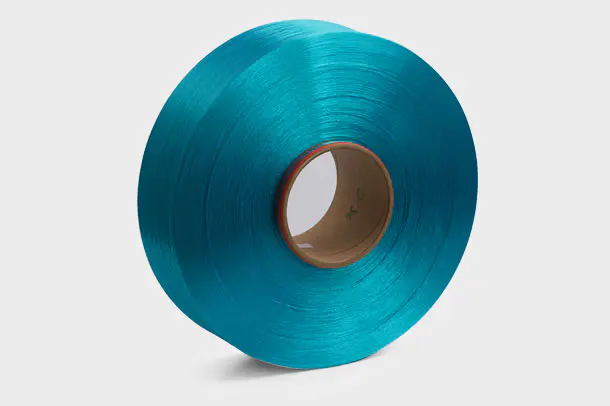 Polyester FDY Yarn Series for Weaving and KnittingFully drawn polyester filament yarn for direct weaving and knitting, with controlled shrinkage and tenacity and elongation reported as mean plus CV.View Product →
A lot passes on its average and fails on its spread. Denier CV percent, tenacity CV percent and elongation CV percent describe what thousands of packages will do on the machine, which is a different question from what ten packages did in the laboratory.
Within-package variation and between-package variation are separate faults. A package that varies inside itself produces periodic tension and barre; a lot whose packages differ from each other produces shade and bulk differences between beams or between rolls.
Benchmarking helps only when the comparison is like for like. Public yarn statistics can place a CV percent figure in context, but yarn type, count and test method must match first; a 150D/48F draw-textured figure is not comparable with a 300D/96F fully drawn figure.
Draw-textured yarn adds two more variables, crimp contraction and crimp stability, both measured by an agreed in-house method, so the report must state the load and dwell time used. A lot with stable crimp contraction still fails in fabric when crimp stability varies between packages, because the bulk of the finished fabric follows it. The test sequence behind these figures is set out in this guide to DTY quality control and test standards.
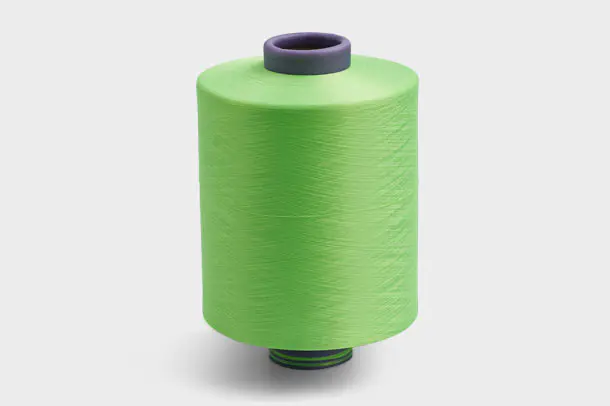 Polyester DTY Yarns with Helical Crimp and BulkDraw-textured polyester filament yarn for circular knitting, warp knitting and weaving, with helical crimp, bulk and crimp stability specified for fabric consistency.View Product →
Testing in the wrong order wastes a week: a lot that fails on designation never needs a full mechanical test, and a lot that fails a machine trial never needed a third laboratory retest.
If you draw-texture in house, the incoming partially oriented yarn sets the draw-textured yield before the texturing machine is threaded. Elongation and its CV percent on that input define the draw ratio window, so both belong in incoming inspection next to denier.
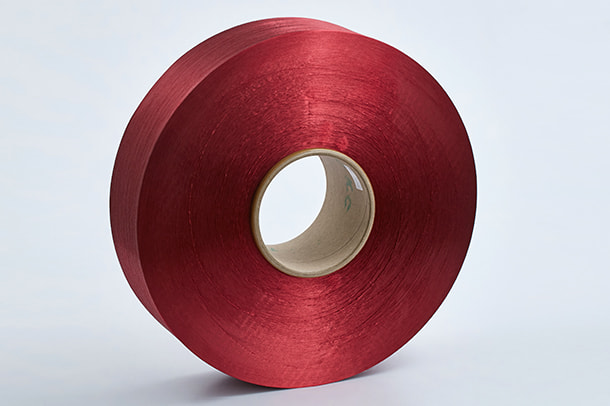 Polyester POY Yarn for DTY and FDY ProductionPartially oriented polyester filament yarn for downstream DTY and FDY production, with elongation and oil pick-up controlled for incoming draw-texturing inspection.View Product →
A test report is comparable only when method, conditioning atmosphere and sampling plan sit next to the result on the same page.
| Report line | Method to expect | What a deviation signals |
| Linear density | ISO 2060 or ASTM D1907 skein method | Off-count yarn changes fabric weight per square metre and cost per metre |
| Linear density CV percent | Same method, multiple packages | Tension variation, barre, uneven cover |
| Breaking tenacity | ISO 2062, constant-rate-of-extension tester | Warp breaks, filamentation, lower beam strength |
| Elongation at break | ISO 2062, same conditions as tenacity | Narrower draw ratio window, more texturing breaks |
| Oil pick-up | Solvent extraction or agreed supplier method | Guide friction, static, filament fusion at heaters |
| Shrinkage | Agreed temperature and dwell time | Dimensional change after finishing, seam puckering |
| Crimp contraction and stability | Agreed load and dwell time, draw-textured yarn only | Bulk and hand variation between rolls |
Process capability is a manufacturing discipline before it is a laboratory number. Zhejiang Hengyuan Chemical Fiber Group Co., Ltd., a polyester filament yarn manufacturer based in Xiaoshan, Hangzhou, publishes its production and development material through its manufacturing and research pages, and buyers assessing a new supplier should request the same capability data behind any certificate.
No. What matters is variation relative to what the next process tolerates. A knitter running fine-gauge fabric gains more from a one-point reduction in elongation CV than from a 0.3-point reduction in denier CV, because tension in the knitting zone follows elongation far more closely than it follows linear density.
Enough to cover the production run, not just the top of the pallet. A workable screen for a hundred-package shipment is ten packages drawn from three production periods and more than one spinning position. That is a purchasing rule of thumb rather than a standard, and the sampling plan belongs in the contract so both sides test the same way.
Yes, often by more than the tolerance being judged. Conditioning time, skein length, gauge length and testing speed all shift the number, and two laboratories reporting 4.0 and 3.8 cN/dtex may simply have used different gauge lengths. Make the ISO 2062 conditions a required field on the certificate.
Denier tolerance, written as a percentage of nominal with the method beside it, for example plus or minus 2 percent to ISO 2060 after ISO 139 conditioning. Add elongation CV second, because it drives tension stability through winding, knitting and weaving more than any other single figure.

Zhejiang Hengyuan Chemical Fiber Group Co.,Ltd. is a professional China polyester filament yarns manufacturers and polyester color yarn suppliers, Established in 2006 ,located in YaQianTown Xiaoshan Hangzhou – One of the Center of polyester yarn Industry in China.

Products
Contact info
Copyright © Zhejiang Hengyuan Chemical Fiber Group Co.,Ltd. All rights reserved