Add: NYaqian Road No128 Yaqian Town Xiaoshan Hangzhou Zhe Jiang China.
Tel: 0086-0571-82602080
Fax: 0086-0571- 82758132
E-mail: [email protected]
Article Directory
Pilling on the face after domestic washing and shade drift between the first and the fourth container are the two defects that turn a blanket yarn trial order into a claim, and neither one appears on a certificate of analysis that reports only linear density.
Polyester filament yarn for home textiles is bought against a short list of measurable properties: linear density, filament count, tenacity and elongation at break, shrinkage, and colour fastness. Each of those properties is fixed at a different point in the spinning, drawing, texturing or colouring route, which is why a specification written after the yarn is already on the water is a specification written too late.
Four values decide a home textile yarn order: linear density in dtex, tenacity and elongation at break, boiling water shrinkage, and colour fastness grade. Every other line on a supplier data sheet exists to support one of those four.
Polyester filament yarn is a continuous multifilament bundle melt-spun from polyethylene terephthalate and drawn to a declared linear density, so it carries no staple crimp and no natural surface hairiness, and every hand-feel property in a finished blanket, carpet or rug has to be engineered into the yarn structure rather than inherited from the fibre.
That single arithmetic step explains most arguments between buyers and spinners. A staple spinner changes hand feel through fibre length and twist; a filament spinner changes it through filament count, cross section, texturing and draw ratio. Two packages can both be sold as 300 dtex polyester and behave like different materials: 300 dtex / 48 filament averages 6.3 dtex per filament and reads crisp, while 300 dtex / 144 filament averages 2.1 dtex per filament and brushes up soft at a higher price.
Because tensile and shrinkage results move with test conditions, the method belongs on the order next to the figure. Ask for linear density under ISO 2060, breaking force and elongation under ISO 2062, and colour fastness to laundering under ISO 105-C06, with samples conditioned to the ISO 139 standard atmosphere of 20 degrees Celsius and 65% relative humidity. A tenacity figure quoted without a method is a marketing number.
Draw-textured yarn (DTY) is the default route for home textiles that need bulk and a soft face, fully drawn yarn (FDY) suits structures that need dimensional stability and clean lustre, and partially oriented yarn (POY) is normally an intermediate that becomes DTY rather than a finished home textile yarn.
| Route | Structural state | Where it fits | Write into the order |
| POY | Partially oriented, low crystallinity, high residual elongation | Feedstock for false-twist or air texturing | Dtex, filament count, oil pick-up, package weight |
| FDY | Fully drawn in the spinning line, higher crystallinity | Warp-knit ground structures, blanket backing, rug backing | Dtex, tenacity, elongation, boiling water shrinkage, interlace |
| DTY | False-twist textured, crimped and bulked | Blanket face and pile, chenille, soft decorative fabric | Dtex, crimp stability, shrinkage, pilling tendency |
| Dope-dyed DTY or FDY | Pigment added to the melt before extrusion | Colour-critical blankets, patterned carpet | Shade standard, fastness grade, colour tolerance |
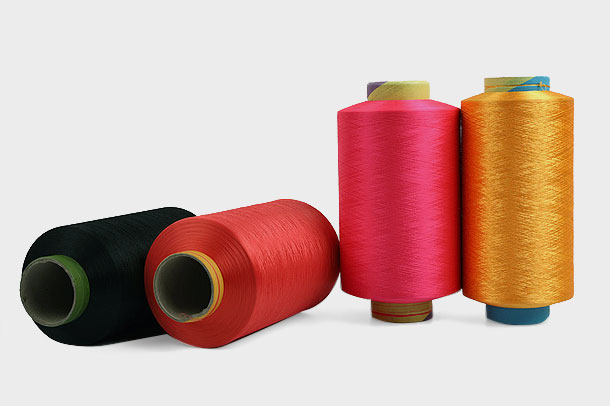
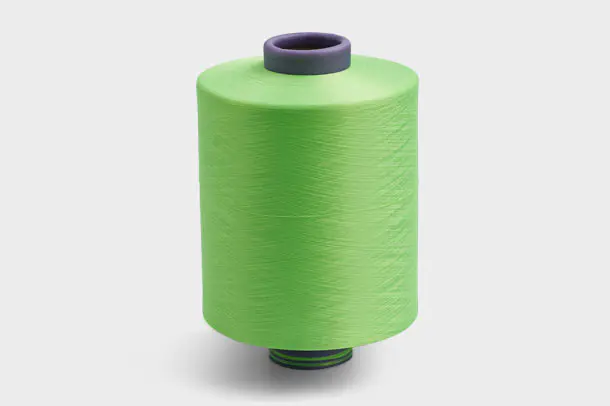 Polyester DTY Filament Yarn for Soft Bulky FabricsFalse-twist draw-textured polyester in 50–600 D with controlled crimp stability and shrinkage for blankets and home textiles requiring bulk.View Product →
Texturing is where a flat yarn becomes a blanket yarn. False-twist texturing introduces helical crimp, which traps air, raises cover and produces the dry, warm hand a blanket face needs. The cost of that bulk is a yarn that stretches, so draw ratio and heat-setting after texturing decide whether the finished blanket keeps its dimensions or grows several percent in length after three washes. If the crimp is unstable, loft collapses on the first wash cycle and the defect traces back to a texturing parameter, not to the polymer.
A blanket yarn specification is a trade-off between bulk, pill resistance and dimensional stability in the wash, and it is settled by three values: total dtex with filament count, shrinkage after the declared heat treatment, and surface filament anchorage in the finished fabric.
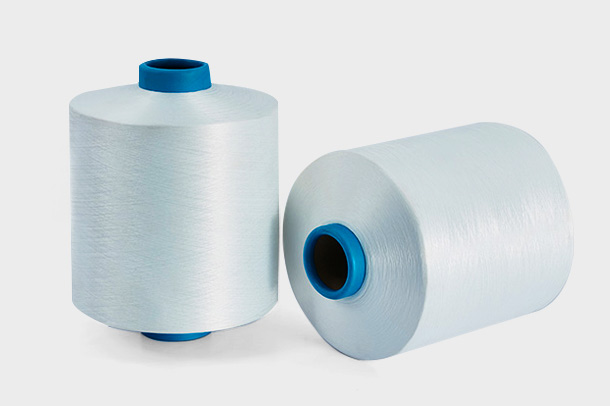 Polyester Blanket Yarn Series for Pile FabricsReview 150–600 D polyester filament options with low DPF and crimp stability for soft pile and dimensional stability in washing.View Product →
Pilling in filament blankets rarely starts with fibre length; it starts when a texturing crimp fails and lets filaments migrate to the surface, or when filaments break in the pile. The countermeasures are mechanical, including a higher interlace level, a tighter twist in the pile yarn, and a brushing and shearing step that removes loose surface filaments before the fabric leaves the finishing line.
Boiling water shrinkage predicts what happens to the blanket in a domestic machine, so specify the value together with the test temperature and exposure time, then confirm it on a full wash cycle of the finished article. A yarn that passes the package-level shrinkage test can still produce a blanket that skews when the greige fabric was stretched during finishing.
For white and pale blankets, shade drift damages more programmes than strength loss does, because two containers that do not match cannot ship to the same retail line. The sourcing notes on white blanket yarn colour consistency set out the tolerances worth fixing before the first bulk lot.
Carpet face yarn is judged on compression recovery and abrasion rather than breaking strength alone, so the specification should pair a bulked continuous filament (BCF) or heat-set DTY face yarn with a declared twist level and a resilience check on the finished pile.
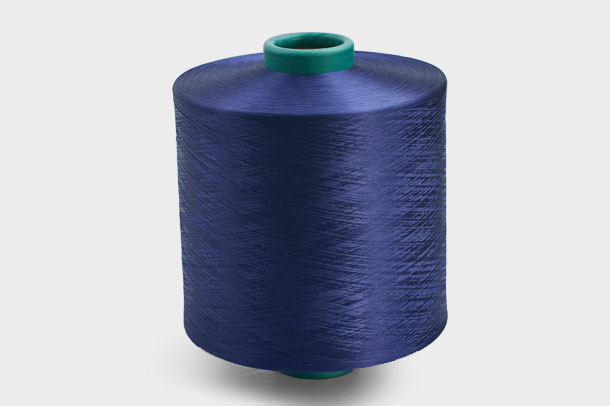 Polyester BCF and Spun Carpet YarnBCF and spun polyester carpet yarns with declared twist, bulk and heat-set stability for cut-pile resilience and abrasion-resistant rugs.View Product →
A cut-pile carpet after a year of foot traffic tests yarn engineering better than any data sheet. Filament yarn recovers because the heat-set crimp and the twist both pull the pile back toward its original angle; if either is under-engineered, the pile flattens and the floor reads as worn long before the fibre has worn out.
Ask for shrinkage and twist figures together with the tufting gauge and pile height the yarn was designed for. A face yarn quoted without a pile height has no reference point, because the same yarn behaves differently at 8 mm and at 15 mm pile.
Rug mat yarn is coarser and stiffer than blanket yarn by design, and the hand-feel argument that governs a blanket does not apply. What matters is abrasion resistance in wet and dry states, colour retention under daylight near windows, and the ability to hold a tufted or printed pattern without streaks. Specify light fastness under ISO 105-B02 for any rug that will sit in daylight, and state the rating you will accept.
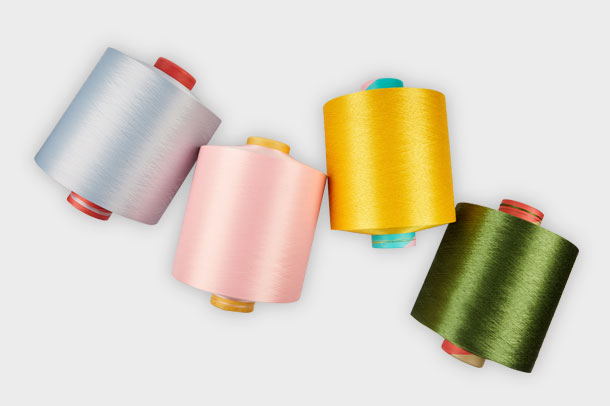
Dope-dyed yarn carries pigment inside the polymer, so the shade is fixed before the filament exists and the package never enters a dye bath, while package dyeing keeps smaller lots and faster shade changes available at the cost of water, energy and a wider lot-to-lot colour window.
For a manufacturer planning a seasonal blanket programme, the decision usually comes down to volume per shade. A single-colour programme in white, ecru or a fixed navy fits the dope-dyed route. A programme built on eight fashion shades that rotate twice a year is easier to serve through package dyeing, even with the added process cost. Whichever route is chosen, the acceptance criterion should be a numeric colour difference measured under a stated illuminant.
An enquiry that states six parameters returns a quotation you can compare, while an enquiry that says polyester yarn for blankets, good quality, returns a price that cannot be compared with anything.
Name the article and the process: raschel blanket, cut-pile tufted carpet, woven rug mat. Add fabric weight or pile height, because the same yarn behaves differently at different pile heights.
Write dtex and filament count together as dtex/f. A single dtex figure leaves the softness of the delivery undefined and invites substitution.
State tenacity and elongation at break, both measured to ISO 2062. Accept no figure that arrives without a test method and a conditioning statement.
Give the boiling water shrinkage limit plus the temperature and time used to measure it, then confirm the value on the finished fabric rather than on the package alone.
Specify dope-dyed or package-dyed, the illuminant for colour matching, a Delta E limit, and the fastness grade required under ISO 105-C06 after laundering.
Fix cone weight, pallet format, minimum order per shade, and require a lot code that traces the delivery back to a spinning date and a test report.
Send the sheet to the plant that spins the yarn rather than only to the trading desk. Reviewing the manufacturing base answers questions a price list cannot: which drawing line the order will run on, how the colour standard is stored, and whether the lot can be traced after delivery.
A false-twist textured DTY between 150 and 300 dtex, with filament count set so filament-level linear density lands near 2 to 3 dtex, is the usual starting point for a brushed blanket face. Fix the exact figure through a trial against your own brushing and shearing line, because the finishing step changes surface hand feel as much as the yarn does.
One dtex equals 0.9 denier, because denier is the mass in grams of 9,000 metres while dtex is the mass in grams of 10,000 metres. A 1,200 dtex carpet face yarn is therefore 1,080 denier, and quoting the wrong unit on an order is a genuine source of dispute at goods-in inspection.
Set the tolerance as a measured colour difference under a stated illuminant, for example a Delta E of 1.0 or tighter under D65 with a 10-degree observer, and pair it with a laundering test under ISO 105-C06 so the shade is compared after washing rather than on the package only.
The test methods stay the same; the documentation changes. An order for recycled polyester filament yarn needs declared recycled content, a traceable feedstock source, and the same tensile, shrinkage and fastness data as virgin yarn. Qualify the lot on finished-fabric trials, because texturing behaviour and shade can differ from a virgin reference even when the data sheet matches.

Zhejiang Hengyuan Chemical Fiber Group Co.,Ltd. is a professional China polyester filament yarns manufacturers and polyester color yarn suppliers, Established in 2006 ,located in YaQianTown Xiaoshan Hangzhou – One of the Center of polyester yarn Industry in China.

Products
Contact info
Copyright © Zhejiang Hengyuan Chemical Fiber Group Co.,Ltd. All rights reserved