Add: NYaqian Road No128 Yaqian Town Xiaoshan Hangzhou Zhe Jiang China.
Tel: 0086-0571-82602080
Fax: 0086-0571- 82758132
E-mail: [email protected]
Article Directory
A facilities team replacing 4,000 square meters of hotel corridor carpet usually finds the same two defects in year three: pile flattened along the walking lanes, and a sunlit run beside the window wall that has faded two shades lighter than the rest of the floor. Neither defect comes from the backing or the underlay. Both are decided at the yarn stage.
Polyester carpet yarn supports durable, colorfast floor coverings because three properties sit inside the fiber itself: filament tenacity, heat-set crimp that springs back after compression, and pigment locked into the polymer instead of coated onto the surface. Contract specifications commonly call for a minimum tuft bind of 3 lbf (13 N) under ASTM D1335 and light fastness of grade 6 on the ISO 105-B02 blue wool scale, and solution-dyed polyester meets both without a topical after-treatment.
Durability in a carpet yarn is a measurable combination of filament tenacity, crimp recovery, and tuft bind, and standard polyester filament covers all three at a tenacity of 3.5 to 4.5 cN/dtex.
Tenacity describes the load a filament carries before it breaks. Standard polyester for carpet use is specified between 3.5 and 4.5 cN/dtex, while high-tenacity grades reach 6.0 cN/dtex and above for industrial loop pile. Crimp recovery decides how quickly a cut pile stands back up after a chair leg has pressed into it for eight hours, which is why heat setting matters as much as polymer choice. Tuft bind describes how firmly the yarn is anchored in the primary backing; below 3 lbf the pile pulls free under a domestic vacuum with a rotating brush.
Polyester also brings a moisture regain of about 0.4 percent at 20 degrees Celsius and 65 percent relative humidity, roughly one tenth that of nylon. Low regain keeps spilled liquid on the surface long enough to be blotted, and it leaves little water inside the pile for mildew to colonize. A supplier write-up of the advantages and applications of polyester carpet yarn follows the same logic from the mill side.
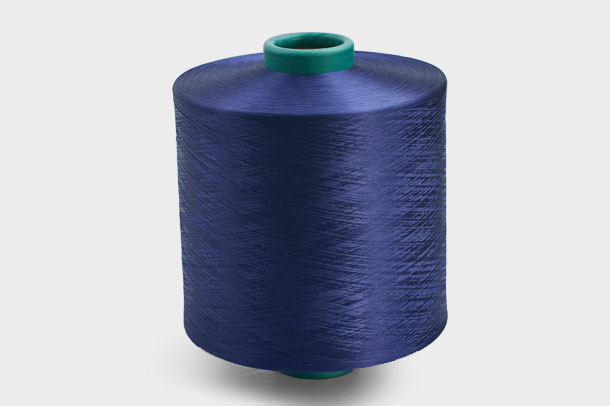 Polyester Carpet and Rug yarns Manufacturerscarpet yarns and rug yarnsView Product →
Solution-dyed polyester reaches light fastness grade 6 to 7 on the ISO 105-B02 blue wool scale because the colorant is dispersed inside the polymer melt, while package-dyed yarn made from the same polymer commonly tests at grade 3 to 4.
Solution dyeing (dope dyeing): a process that adds colorant to the polyester polymer before or during melt spinning, so every filament is colored through its full cross-section rather than on its surface. There is no dye layer to scour off.
That structural difference explains why solution-dyed yarn survives the three forces that strip color from a floor covering: ultraviolet light through a window, repeated hot-water extraction, and abrasive cleaning compounds. It also removes the aqueous dye bath from the production chain, which is why the same route serves outdoor rugs and contract carpet that cannot be re-dyed on site.
| Coloring route | Where the color enters | ISO 105-B02 grade | Best fit |
| Solution dyed | Polymer melt | 6 to 7 | Contract carpet, outdoor rugs, high-UV rooms |
| Stock dyed | Loose fiber before spinning | 5 to 6 | Mid-volume custom shades |
| Package dyed | Aqueous bath after spinning | 3 to 4 | Small batches and short fashion runs |
Those grades are typical specification ranges, not guarantees. Ask the mill for test reports on the production lot, and set a lot-to-lot color difference of dE 1.0 or less under D65 illumination whenever an installation continues past a doorway.
Six laboratory tests predict most field failures of contract carpet: tuft bind, appearance change after drum wear, light fastness, rub fastness, electrostatic propensity, and pile mass per unit area.
| Test | Standard | Typical contract target | Failure it prevents |
| Tuft bind | ASTM D1335 | 3 lbf (13 N) minimum for loop pile | Tufts pulled free by vacuum or snagging |
| Appearance change after wear | ISO 10361 with ISO 9405 | Grade 3 or better after 12,000 drum cycles | Traffic lanes flattening and losing texture |
| Color fastness to light | ISO 105-B02 | Grade 6 minimum | Window fade and patchy color across a room |
| Color fastness to rubbing | ISO 105-X12 | Grade 4 minimum | Color transfer onto socks and cleaning cloths |
| Electrostatic propensity | AATCC TM134 | Below 3.5 kV | Shocks at door handles in dry indoor air |
| Pile mass per unit area | ISO 8543 | Project specific | Premature wear-through in entrances |
A durable polyester carpet yarn passes six controlled stages, and each stage leaves a measurable signature on the finished carpet.
Control at these stages separates a yarn that holds grade 6 light fastness from one that fades in a conservatory. The group publishes a manufacturing overview covering spinning, texturing, and the equipment behind its yarn lines.
Contract polyester carpet yarn is usually specified between 1,000 and 3,000 denier for the pile bundle, and the filament count inside that bundle decides how the pile reflects light and how quickly it crushes.
The chart below shows the light fastness grades normally written into specifications for each coloring route.
Where a floor covering must meet a target beyond standard polyester, the conversation shifts to specialty yarns. The group lists a functional yarn series alongside its standard filament ranges, and any flame retardant, antibacterial, or antistatic claim should be supported by a test report for that specific function.
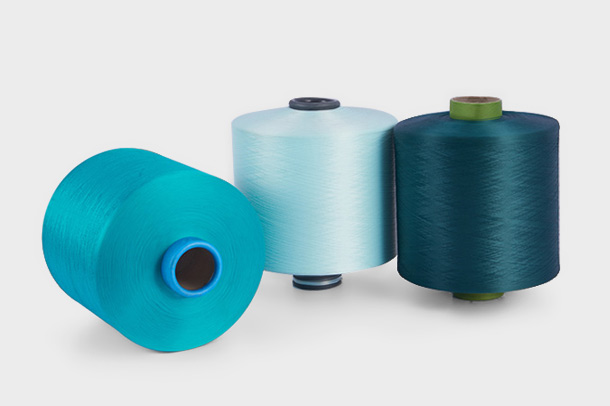 Functional Yarn ManufacturersPerformance Integration at the Yarn Stage: Functional properties engineered into the yarn — through polymer modification, fiber cross-section design, or additive incor...View Product →
Polyester is the wrong choice when cleaning water above 60 degrees Celsius is standard practice, when strict static control is required in a dry electronics environment, or when traffic intensity demands the higher resilience of nylon.
Where polyester wins
Where it needs care
None of these limits is hidden from a buyer who asks the right questions. A written cleaning protocol that caps water temperature at 60 degrees Celsius and specifies a pH-neutral detergent protects most of the service life the yarn was specified to deliver.
In a room with filtered daylight and routine cleaning, a solution-dyed yarn testing at grade 6 to 7 on ISO 105-B02 normally keeps its original shade for the full 10 to 15 year life of a contract installation. Package-dyed yarn at grade 3 to 4 shows measurable fade within three to five years in the same window position.
For a medium-traffic office, 1,100 to 1,500 denier pile yarn with a tuft bind above 3 lbf covers most specifications. Corridors and entrances handling more than 5,000 people per day are normally built on 2,000 to 2,600 denier yarn in a two-ply or three-ply construction.
Yes, within limits. Polyester melts near 255 degrees Celsius but softens well before that, so extraction water should stay at or below 60 degrees Celsius, dwell time should be short, and the carpet should be dried with air movement. Chlorine bleach should never be used on colored polyester pile.
Zhejiang Hengyuan Chemical Fiber Group Co., Ltd. has manufactured polyester filament and colored yarn in Hangzhou since 2006, with carpet and rug yarn as one of its named product lines. Buyers comparing carpet yarn suppliers before a project can request specifications, shade cards, and test reports through the contact details published on the site.

Zhejiang Hengyuan Chemical Fiber Group Co.,Ltd. is a professional China polyester filament yarns manufacturers and polyester color yarn suppliers, Established in 2006 ,located in YaQianTown Xiaoshan Hangzhou – One of the Center of polyester yarn Industry in China.

Products
Contact info
Copyright © Zhejiang Hengyuan Chemical Fiber Group Co.,Ltd. All rights reserved