Add: NYaqian Road No128 Yaqian Town Xiaoshan Hangzhou Zhe Jiang China.
Tel: 0086-0571-82602080
Fax: 0086-0571- 82758132
E-mail: [email protected]
Article Directory
A plant running a double-layer raschel line at 400 gsm and a plant running coral fleece at 260 gsm can order the same 150 D/144 F polyester package and still disagree about whether the yarn is good. The denier and filament count match; the tenacity, shrinkage, crimp and spin finish do not. Blanket yarn is bought on a written specification, not on a count, and that specification has to exist before the first sampling round begins.
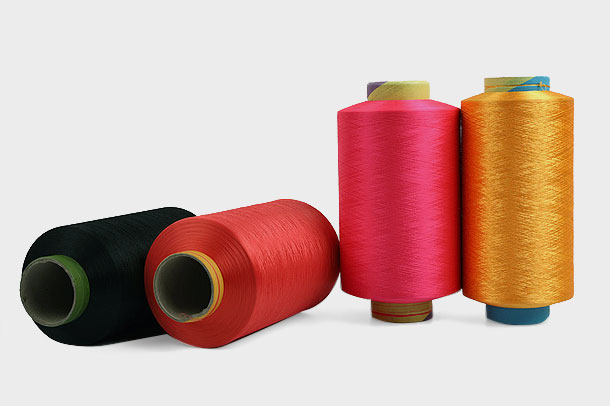
Polyester blanket yarn is a continuous-filament polyethylene terephthalate (PET) yarn, normally draw-textured or air-textured, produced for pile fabrics where bulk, softness, dimensional stability and colourfastness matter more than the high tenacity used in industrial yarns.
Definition: polyester blanket yarn is a textured PET filament yarn, commonly 150 D to 450 D with 72 to 288 filaments, supplied bright, semi-dull or dope-dyed, and purchased on tenacity, elongation, boiling water shrinkage, crimp and spin finish rather than on denier alone.
The fibre's moisture regain of about 0.4% at 20 degrees Celsius and 65% relative humidity, the standard atmosphere defined in ISO 139, explains most of its blanket behaviour. A polyester blanket dries quickly, does not feed mildew and resists moth damage, but the same low regain makes static and oil pickup visible problems, so spin finish choice carries more weight here than in apparel yarn.
POY is the partially oriented feedstock, FDY is fully drawn, and DTY is textured for bulk and stretch. Blanket pile is built on textured yarn, and the drawing and texturing stages set the shrinkage and crimp window the finisher inherits, which is why process control and yarn development decide as much about the finished blanket as the polymer grade does.
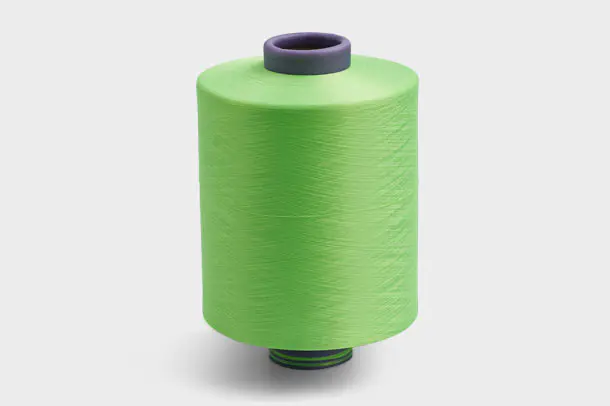 Polyester DTY Yarns for Blanket PileFalse-twist draw-textured polyester with helical crimp, bulk and uniform dyeability; review grades and specifications when yarn development shapes blanket pile performance.View Product →
The correct polyester grade is decided by three inputs: how the blanket is brushed or bonded, how long the colour run is, and whether a recycled-content claim must be documented.
| Yarn route | Best fit | What the buyer must control |
| Bright trilobal textured polyester | Printed and brushed coral fleece | Cross-section profile and lot-to-lot lustre, confirmed on the mill specification sheet |
| Semi-dull or full-dull textured polyester | Solid-colour and matte blankets | Titanium dioxide content, which shifts dye shade, so keep one supplier per shade |
| Dope-dyed (solution-dyed) polyester | Long colour runs and laundry-fast retail programs | Colour tolerance, minimum quantity per colour and spin-finish compatibility |
| Recycled polyester with GRS certification | Programs carrying a recycled-content claim | Transaction certificates and the 20% minimum recycled content of the Global Recycled Standard |
| Cationic-dyeable polyester | Two-tone and cross-dye effects | Dye-house capability and shade-recipe control |
| Low-melt binder filament blends | Thermal-bonded nonwoven blankets | Bonding temperature window and the residual hand after bonding |
Colour deserves a written limit: a maximum colour difference of Delta E00 1.0 against the approved standard, measured under D65 lighting, holds panels consistent across lots. White and pale grounds need their own fibre specification, covered in this guide to fibre selection for white blanket yarn.
Selection rule in one line: choose the colour route before anything else, because dope-dyed yarn fixes shade in the melt and a later switch forces a new sampling round, a new minimum quantity and a new fastness file.
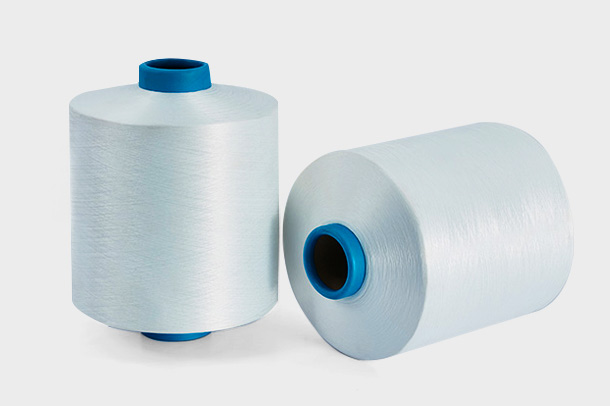 Polyester Blanket Yarn Series for Pile FabricsCompare denier, luster, microfiber, cationic and recycled variants; specify measurable yarn parameters before fixing colour route and blanket construction.View Product →
A blanket yarn order needs at least eight numbers, and each number needs a test method attached, because the phrase standard quality has no measurable meaning on a knitting floor.
| Parameter | Typical order window | Test reference | Effect on the blanket |
| Tenacity, single-end | 3.2 to 4.5 cN/dtex | ISO 2062 or ASTM D2256 | Pile crush resistance and pull-out during brushing |
| Elongation at break | 18% to 30% | ISO 2062 | Fewer breaks in carding and knitting; loop recovery |
| Boiling water shrinkage | 3% or less for wash-stable specs | In-house boil test on conditioned yarn | Length and width change after the first wash |
| Crimp stability | Held across lots per supplier data | Crimp tester, supplier method | Bulk, cover and hand feel |
| Spin finish (OPU) | 0.3% to 1.0% | Extraction or supplier certificate | Static, fly and carding efficiency |
| Interlace | 60 to 100 knots per metre | Pin count | Unwinding at speed and package stability |
| Colourfastness to washing and rubbing | Grade 4 or better on the ISO grey scale | ISO 105-C06 and ISO 105-X12 | Care-label claims and complaint rate |
| Pilling | Agreed grade | ISO 12945-2, Martindale | Surface appearance after repeated use |
Those windows are commercial starting points, not requirements written into any standard. Each value must be measured on yarn conditioned in the ISO 139 atmosphere, and the same method must appear on the purchase order and on the supplier's certificate of analysis.
Where blanket claims start: shrinkage produces length change, spin finish produces static and fibre shedding, and colourfastness produces wash complaints. Fix limits for these three in the first sampling round; the remaining parameters can be tightened later without renegotiating the whole order.
Filament count controls softness more than total denier does: 150 D split into 144 filaments gives about 1.04 denier per filament, while 150 D split into 36 gives about 4.2, and the two yarns behave like different fibres on a brushing line.
Finer filaments build softer, denser pile with better opacity at a given weight, but they shed more fibre during brushing and show pilling sooner. A brushed coral fleece specification that lands between 1.0 and 1.5 denier per filament balances hand feel against shedding. Coarser filaments hold loft at high fabric weights and resist pile crush, so a heavy double-layer raschel blanket gains nothing from ultra-fine filaments except cost.
Dope-dyed polyester fixes colour in the polymer before extrusion, which removes dye-bath variation, but it adds a minimum quantity per colour and a longer first delivery.
Run length decides the answer. Where a colour is planned to repeat across seasons and panels are large, dope-dyed yarn removes a whole class of complaints; where the range changes every season, piece dyeing keeps inventory flexible.
Six checks catch most blanket yarn failures before production: document review, conditioning, tensile testing, shrinkage, a knit trial and retained samples.
Illustrative Example: a 200 x 240 cm blanket at 300 gsm uses 4.8 square metres of pile fabric, or 1.44 kg of yarn before process loss. At an assumed 10% loss in carding, brushing and trimming, the order quantity is 1.58 kg per piece. The 10% figure is an assumption for planning and should be replaced with the mill's measured loss before any purchase quantity is fixed.
An RFQ for blanket yarn should carry fabric construction, colour route, test methods and acceptance limits, so two suppliers end up quoting the same product.
Zhejiang Hengyuan Chemical Fiber Group Co., Ltd., a polyester filament and coloured yarn manufacturer based in Xiaoshan, Hangzhou, lists a dedicated blanket yarn series alongside its DTY, FDY and POY lines, which allows pile yarn and textured base to be discussed against one specification sheet instead of two.
Polyester is the safer base when the blanket must survive repeated machine washing: its moisture regain is about 0.4%, against roughly 1.3% for acrylic, so it dries faster and holds less odour. Acrylic keeps more warmth per gram and a softer initial hand.
Between 3.2 and 4.5 cN/dtex measured to ISO 2062 covers most blanket pile. Below 3.0 cN/dtex, pile pull-out and brushing damage rise sharply; above 5.0 cN/dtex the yarn feels harder and drapes less.
A maximum colour difference of Delta E00 1.0 against the approved standard, measured under D65 lighting, is workable for blanket colours. At Delta E00 2.0 or above, a shade shift becomes detectable across a full panel.
One specification covers roughly 250 gsm to 400 gsm if the shrinkage and crimp limits are wide enough. Below that range a finer denier per filament is needed for cover; above it a coarser filament resists pile crush better.

Zhejiang Hengyuan Chemical Fiber Group Co.,Ltd. is a professional China polyester filament yarns manufacturers and polyester color yarn suppliers, Established in 2006 ,located in YaQianTown Xiaoshan Hangzhou – One of the Center of polyester yarn Industry in China.

Products
Contact info
Copyright © Zhejiang Hengyuan Chemical Fiber Group Co.,Ltd. All rights reserved