Add: NYaqian Road No128 Yaqian Town Xiaoshan Hangzhou Zhe Jiang China.
Tel: 0086-0571-82602080
Fax: 0086-0571- 82758132
E-mail: [email protected]
Article Directory
Two bobbins can carry the same denier number and still produce completely different fabrics. A 75D/36F polyester fully drawn yarn and a 75D/72F polyester FDY weigh the same per 9,000 meters, but the second one contains twice as many filaments, each roughly half as thick. They feel different, dye differently, and behave differently on a weaving machine or knitting frame. For this reason, filament count is one of the first specifications a textile buyer should verify, not simply an optional detail on a data sheet.
Here is the conclusion up front: at a fixed denier, a higher filament count makes the yarn softer, more flexible, faster to dye, and better at covering a fabric surface, while a lower filament count makes the yarn firmer, more damage-tolerant, and easier to handle under high tension. Neither option is universally better. Quality depends on how well the filament count matches the end use and on how consistently it is controlled during production. That is exactly what this article will help you evaluate.
A fully drawn yarn is not a single round thread. It is a bundle of continuous filaments laid side by side, and its specification normally contains two numbers. In "100D/48F," the first number is total linear density in denier, the weight in grams per 9,000 meters; the second is the number of filaments in that bundle. Dividing total denier by filament count gives the denier per filament, or DPF, which is the actual thickness of one filament.
A 100D/48F yarn has a DPF of about 2.08, while a 100D/96F yarn with the same total denier has a DPF of about 1.04. The weight of the yarn has not changed; only the distribution across filaments is different. That difference is the origin of most visual and tactile differences in the finished fabric.
Filament count is fixed at the earliest stage of melt spinning, when polymer is extruded through the holes of a spinneret. The drawing step that follows orients the molecular chains and builds tenacity, but it cannot change the number of filaments. When a supplier quotes 75D/72F or 75D/144F, the structure of the yarn was already determined upstream. This is why the full designation belongs on your purchase order, not just the denier.
Four properties carry the most weight for buyers of polyester FDY: softness, strength behavior, dyeing, and surface appearance. Filament count influences all four.
Finer filaments bend more easily than coarse ones. At the same denier, a 150D/288F FDY will feel noticeably softer and more supple than a 150D/48F FDY from the same production line. Fabrics from high-filament-count yarns drape better, which explains why fine-filament FDY appears frequently in apparel linings and bedding. The practical test is simple: touch the woven sample, not just the yarn package.
Overall tenacity is set mainly by polymer quality and drawing conditions in the production line. Filament count then decides how the load is shared. In a coarser count such as 48F, each filament carries a larger share of the force and is less delicate, so the yarn survives aggressive weaving or high-tension warping with fewer filament breaks. In a fine count such as 144F, individual filaments are more fragile, and tension control becomes more important. The strongest specification on paper is not automatically the most stable in your machine.
Thinner filaments create a larger total surface area per unit of yarn mass. That surface attracts dye faster and allows dye to penetrate more evenly, which is why high-filament-count FDY usually shows quicker dye uptake and better levelness. The same sensitivity requires more careful control of temperature and dye concentration; a dye house should adjust the heating rate for fine-count yarns to prevent shade differences inside a batch.
More filaments per bundle also improve coverage. A 75D/144F yarn blocks more light and fills more space in the fabric than a 75D/36F yarn of identical denier, so the final cloth looks denser and more uniform. The trade-off appears in pilling: very fine filaments are more mobile in low-twist constructions and can migrate to the surface, creating fuzz and pills. Coarser filaments stay in place better, which is one reason heavy-use upholstery fabrics often rely on lower filament counts.
The same logic applies at any denier, but a 75D example makes the difference easy to read. The table below compares three common filament counts of the same final denier.
| Characteristic | 75D/36F | 75D/72F | 75D/144F |
|---|---|---|---|
| Denier per filament | 2.08 | 1.04 | 0.52 |
| Hand feel | Firm, crisp | Supple, balanced | Soft, fluid |
| Dyeing behavior | Slower uptake | Even and predictable | Fast uptake, high levelness |
| Coverage | Moderate | Good | Excellent |
| Typical end uses | Woven outerwear, bags, upholstery | Linings, general weaving, knit fabrics | Apparel, soft-touch textiles |
Choose a coarser count when stiffness, weaving efficiency, and abrasion resistance matter. Choose a finer count when softness, coverage, or dyeing speed is the priority. The medium range, 72F in this denier, is often the safest starting point for a new product.
End-product requirements should drive the decision, not habit. The following guidance covers the three most common buying situations.
Suppliers with a broad FDY range make this selection process easier. You can review available deniers and filament counts in the polyester FDY series before contacting a sales engineer. If your own production starts from partially oriented yarn for further drawing or texturizing, filament count deserves the same scrutiny in your POY purchasing, since it determines the fineness of the final product; the polyester POY series is a useful reference for upstream sourcing.
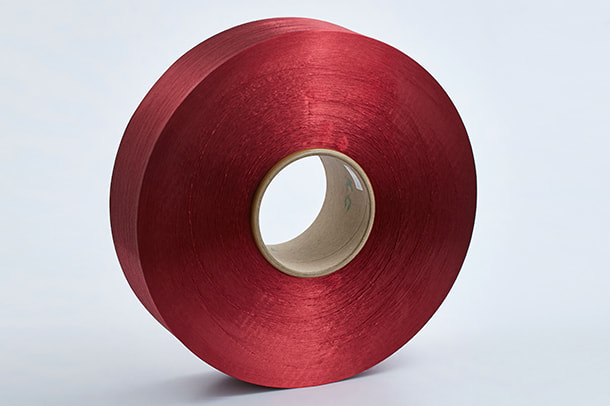 China Wholesale Polyester POY Yarns Manufacturers, SuppliersZhejiang Hengyuan Chemical Fiber Group Co.,Ltd is China polyester POY Yarns manufacturers and polyester POY Yarn suppliers, factory offer...View Product →
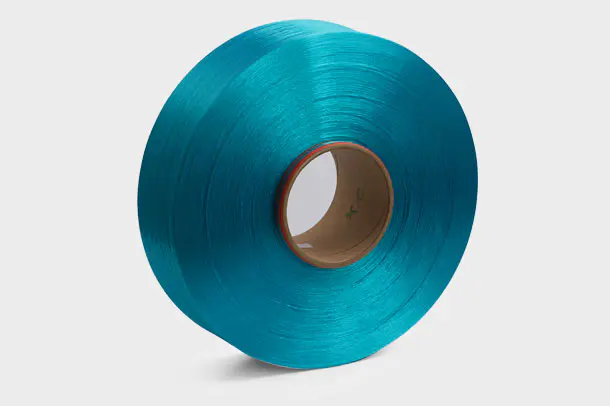 China Wholesale Polyester FDY Yarns Manufacturers, FactoryAs a China polyester FDY Yarns manufacturers and polyester FDY factory, Zhejiang Hengyuan Chemical Fiber Group Co.,Ltd. provide wholesale...View Product →
For a more detailed view of how denier and filament structure shape fabric behavior, this analysis of how FDY denier count impacts textile applications explains the relationship in practical terms.
Never order FDY by denier alone. Write the filament count directly into the purchase order: 75D/72F, not just 75D. Confirm the tolerance with the manufacturer, and ask for the actual measured filament count of the production lot. If a supplier cannot state it clearly, treat that as a red flag.
Ask for test results on tenacity, elongation, and elongation variation for each lot. A steady elongation value along the entire package is a stronger quality signal than a high average. Test methods should follow standard procedures; a description of tenacity and elongation control for FDY shows what to look for in the certificates.
The most convincing check is a trial on your own machine. Run the FDY through warping or knitting, count filament breaks, and dye a small batch to inspect levelness. A trial costs a fraction of a rejected shipment and reveals differences that no data sheet can communicate.
Filament count expresses something that denier alone cannot: softness, dyeing speed, coverage, processing stability, and pilling resistance all shift with the number of filaments in the bundle. A clear specification that includes both denier and filament count, supported by lot-level quality data, prevents a large share of fabric defects before production starts. When suppliers quote FDY, ask for the full designation and for the test results behind it. When the choice is not obvious, a few sample bobbins and a trial run will answer the question faster than any brochure.

Zhejiang Hengyuan Chemical Fiber Group Co.,Ltd. is a professional China polyester filament yarns manufacturers and polyester color yarn suppliers, Established in 2006 ,located in YaQianTown Xiaoshan Hangzhou – One of the Center of polyester yarn Industry in China.

Products
Contact info
Copyright © Zhejiang Hengyuan Chemical Fiber Group Co.,Ltd. All rights reserved