Add: NYaqian Road No128 Yaqian Town Xiaoshan Hangzhou Zhe Jiang China.
Tel: 0086-0571-82602080
Fax: 0086-0571- 82758132
E-mail: [email protected]
Article Directory
A polyester yarn that measures 0.4 cN/dtex below its declared tenacity will pass a visual inspection and then fail on a tufting machine three weeks later, as slubs, warp stops and a rejected dye lot. Yarn selection for home textile manufacturing is not a price comparison. It is a specification exercise built on roughly a dozen measurable parameters: linear density, filament count, tenacity, elongation, shrinkage, crimp contraction, colour difference between lots, fastness grades, and the supplier's ability to repeat every one of them on the next container.
Get those parameters in the right order and most of the specification writes itself. Get the order wrong, and no amount of incoming inspection recovers the margin on a 20,000 piece order.
The finished article decides the yarn specification, and no other input comes close in importance: a 1,200 gsm tufted carpet, a 220 gsm raschel blanket and a 90 gsm bedding fabric cannot be produced from the same polyester yarn, however good that yarn looks on a data sheet.
Fix four product parameters first. Weight per square metre, pile or loop height, construction route (tufting, rapier weaving, warp knitting or raschel), and the cleaning regime the article will face in service. A product washed weekly at 60 C needs different shrinkage stability and fastness behaviour from one that is vacuumed twice a week.
| Finished article | Dominant requirement | Yarn route | Typical linear density |
| Blanket and throw | Bulk and softness | Textured DTY | 150-300 denier |
| Carpet and rug | Resilience and recovery | Heat-set BCF or FDY | 1,000-3,000 denier |
| Upholstery | Abrasion resistance | Plied DTY | 300-600 denier |
| Bedding and sheeting | Evenness and hand | FDY or spun | 50-150 denier |
| Curtain and drapery | Drape and lustre | Trilobal FDY | 75-150 denier |
Linear density, filament count, tenacity and shrinkage carry more weight than every other parameter combined, because they are the four values a tufting machine, a warp beam or a raschel bed reacts to directly.
Linear density is quoted in denier (grams per 9,000 metres) or dtex (grams per 10,000 metres). 300 denier equals 333 dtex, and both units circulate interchangeably across Asian and European supply chains. Filament count turns that weight into a surface. A 300D/96F yarn spreads its mass across 96 filaments and lands at roughly 3.1 denier per filament, while a 300D/36F yarn reaches 8.3. Denier per filament above 6 gives a coarser, wool-like hand that suits carpet and heavy upholstery. Below 2 gives the fine, silk-like handle demanded in bedding, at higher spinning cost and greater breakage risk.
For blankets, covers and upholstery the textured route is the workhorse, because the crimp it carries is what creates thickness without adding weight per square metre.
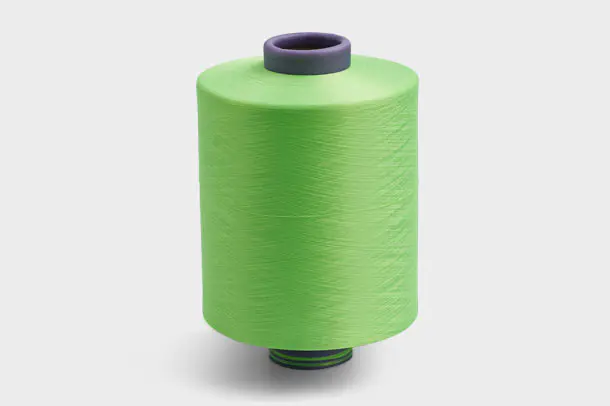 Polyester DTY Yarn for Textured FabricsFalse-twist textured polyester filament yarn with helical crimp, soft hand, elastic recovery, and uniform dyeability for blankets, upholstery, knitwear, and apparel fabrics.View Product →
Tenacity is measured as breaking force per unit linear density to ISO 2062 or ASTM D2256, and standard fully drawn polyester is normally supplied between 3.6 and 4.2 cN/dtex. A 10% shortfall is enough to raise warp stops on a high-speed rapier loom and to pull tufting efficiency down on a wide machine.
Elongation at break runs between 20% and 30% for FDY and between 25% and 40% for DTY. A yarn that is strong but brittle breaks at the needle. A yarn that is ductile but weak stretches under tension and forms uneven pile. Both extremes appear as seconds, not as a failed laboratory report.
Residual shrinkage decides what happens after the first domestic wash. Boiling water shrinkage sits in the 50-70% band for partially oriented yarn, 3-8% for fully drawn yarn and 2-4% for textured yarn. Warp and weft yarns must be matched, because a shrinkage difference between the two directions only reveals itself once heat and water are applied.
Blanket and throw quality is decided by crimp contraction and pilling resistance rather than by tenacity: a textured yarn with crimp contraction below 12% produces a flat, thin hand at the same weight per square metre, and the customer feels the difference before any test report is opened.
Crimp contraction is measured to ISO 18067. Blanket DTY generally runs 15-25% crimp contraction, with the upper part of that range reserved for lighter, loftier constructions. Interlace nodes control how the yarn behaves at the knitting needles: too few nodes and the yarn splits on the creel, too many and the finished fabric stiffens noticeably.
Pilling is the second failure mode, assessed to ISO 12945-2 on Martindale equipment. A blanket yarn should reach grade 4 after 2,000 rubs. Denier per filament and the fibre migration behaviour of the blend decide whether it does.
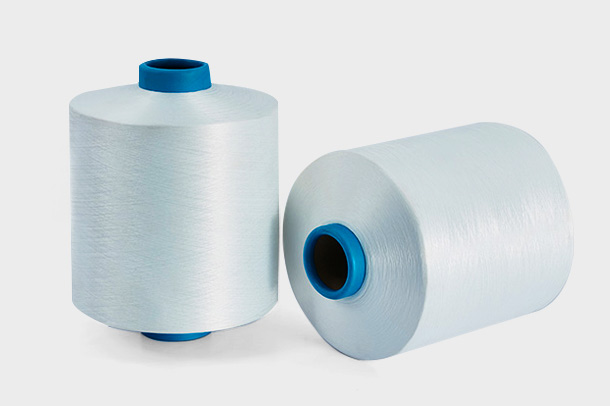 Polyester Blanket Yarn Series for High-Bulk PilePolyester filament yarn for fleece, sherpa, and plush blankets, offering high bulk, soft hand, crimp stability, and color retention through napping and heat-setting.View Product →
Dope-dyed polyester, also called solution-dyed or spun-dyed, carries pigment inside the polymer melt before extrusion. It removes the dyeing stage from the finishing line and holds light fastness at grade 5 or better on the ISO 105-B02 blue wool scale, where piece-dyed polyester generally lands between grade 3 and grade 4.
Package dyeing remains the right answer for short runs and rapid colour changes, because it carries no minimum melt batch and no extrusion changeover. The trade-off is a wet process, an effluent load and the residual risk of a re-dye that the customer will see.
Whatever route is chosen, three numbers belong in the contract: colour difference between lots, metamerism and fastness. A workable clause asks for a CIELAB colour difference no greater than 1.0 between successive lots under D65 illumination, with no visible metameric shift under illuminant A.
| Property | Test standard | Typical contract minimum |
| Light fastness | ISO 105-B02, AATCC 16 | Grade 4 on the blue wool scale |
| Colour difference between lots | CIELAB under D65 | Delta E of 1.0 or less |
| Crocking | ISO 105-X12 | Grade 4 dry, grade 3 wet |
| Laundering | AATCC 61, test 2A | Grade 4 |
| Perspiration | ISO 105-E04 | Grade 4 |
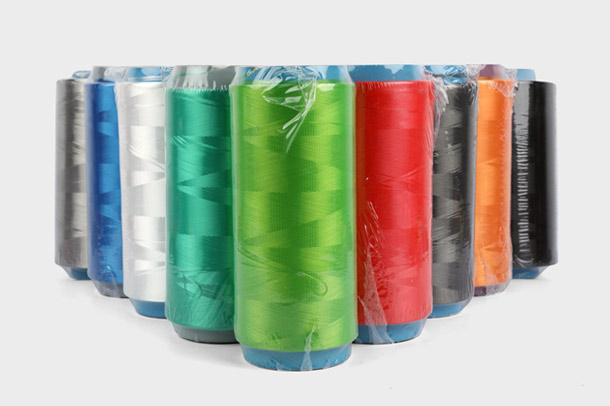
Colour programmes live or die on lot discipline. Before committing to a shade, review the colour yarn selection criteria that apply to your construction and light exposure.
Carpet and rug yarn is judged on resilience, tuft definition and soil behaviour rather than on filament count, and heat-set bulked continuous filament polyester between 1,000 and 3,000 denier is the standard starting point for cut-pile residential carpet.
Heat setting fixes the twist so the pile recovers after foot traffic instead of flattening permanently. Bulk level, crimp rigidity and tuft bind strength are the three values that separate a carpet that looks new after three years from one that looks tired after three months.
Polyester's 0.4% moisture regain against 4.5% for nylon 6 explains most of the specification choices in this category: polyester dries faster and resists water-borne staining, while nylon recovers more completely from compression.
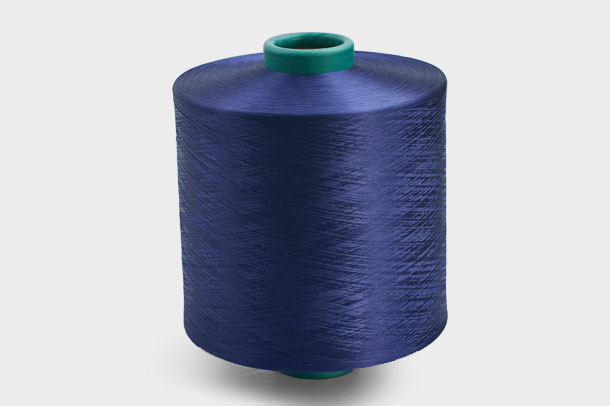 BCF and Spun Polyester Carpet YarnPolyester BCF and spun yarns for durable carpet and rugs, with abrasion resistance, pile resilience, solution-dyed colorfast options, and recycled rPET grades.View Product →
Three documents settle most compliance questions in home textile sourcing: an OEKO-TEX Standard 100 certificate issued for the correct product class, a declaration covering the current REACH candidate list of substances of very high concern, and, where recycled fibre is claimed, Global Recycled Standard transaction certificates that name the producing mill.
Product class II of OEKO-TEX Standard 100 covers articles with large skin-contact surfaces, which is the class that applies to bed linen and blankets. Class IV covers furnishing and decoration. Certificates run for twelve months, so an expired document is not evidence of anything.
A producer answers specification questions with line counts, polymer grades and in-house test data. A trader answers with a specification sheet and a price, and the difference surfaces six weeks into a contract when the first off-grade container needs replacing.
Qualify the supplier on five points, in this order. Polymer source and chip specification. Spinning capacity and the number of extrusion lines. In-house testing for linear density, tenacity, elongation and shrinkage. Colour capability, meaning whether the mill runs its own dope-dyeing rather than outsourcing it. Documentation, including lot retention samples and a named technical contact.
A manufacturer that can show its own filament spinning and quality-control operations is answering a different question from one that forwards a PDF.
The cheapest quotation is rarely the cheapest yarn, because dyeing, off-grade waste, machine stops and customer claims all scale with incoming variability, and none of those costs appear on the purchase order.
Dope-dyed yarn is quoted above natural yarn per kilogram, yet it removes a wet process together with its water, energy and effluent charge, and it eliminates the risk of a re-dye batch. For a mill running a continuous colour programme, that removal is usually the single largest cost decision in the whole yarn specification.
Most blankets and throws are knitted from textured DTY between 150 and 300 denier, at 2 to 4 denier per filament, with crimp contraction of 15-25% measured to ISO 18067. Dropping below 2 denier per filament raises both cost and breakage rate without improving the hand enough to justify it.
Dope-dyed yarn is quoted higher per kilogram than natural yarn. Calculated per finished square metre the balance usually reverses, because the dyeing stage, its water and energy demand and the re-dye risk all disappear from the finishing line.
Ask for lot-specific data to ISO 2062 for tenacity and elongation, ISO 2060 for linear density and ISO 18067 for crimp contraction, with the sample identification and test date no older than twelve months. Retain a sealed sample of every accepted lot for the length of the contract.
OEKO-TEX Standard 100 at product class II, renewed within the last twelve months, covers the articles with the largest skin-contact area in the home textile range. Add a REACH SVHC declaration for the current candidate list, and a GRS transaction certificate when recycled content is claimed.

Zhejiang Hengyuan Chemical Fiber Group Co.,Ltd. is a professional China polyester filament yarns manufacturers and polyester color yarn suppliers, Established in 2006 ,located in YaQianTown Xiaoshan Hangzhou – One of the Center of polyester yarn Industry in China.

Products
Contact info
Copyright © Zhejiang Hengyuan Chemical Fiber Group Co.,Ltd. All rights reserved