Add: NYaqian Road No128 Yaqian Town Xiaoshan Hangzhou Zhe Jiang China.
Tel: 0086-0571-82602080
Fax: 0086-0571- 82758132
E-mail: [email protected]
Article Directory
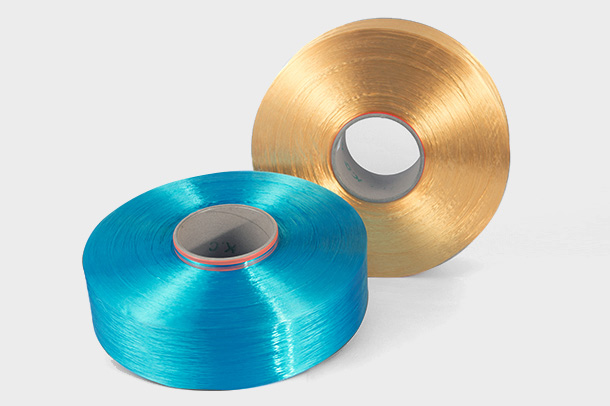
Polyester POY yarns — Partially Oriented Yarn — occupy a unique and indispensable position in the polyester textile supply chain. Produced by melt-spinning PET polymer at winding speeds of 3,000 to 3,600 metres per minute, POY is intentionally left in a semi-crystalline, under-drawn state. This incompleteness is not a defect — it is the design. The residual molecular orientation and latent drawability built into every POY package determine the eventual tenacity, elongation, and texture of the finished DTY and FDY yarns that flow downstream into global fabric production.
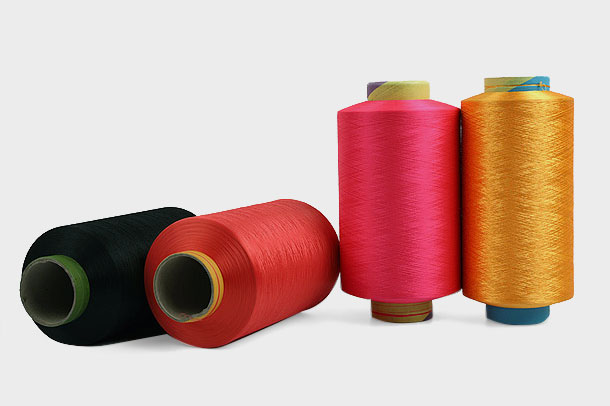
Polyester POY yarn is used primarily as the upstream intermediate feedstock for the production of Drawn Textured Yarn (DTY) and Fully Drawn Yarn (FDY) — the two finished yarn types that enter weaving, warp knitting, and circular knitting mills globally. POY itself is rarely the final product; its value lies in the conversion potential locked inside its semi-oriented molecular structure.
POY conversion follows two distinct mechanical pathways — false-twist texturing for DTY and draw-winding for FDY. Both pathways exploit the same property: POY's undrawn molecular chains can be oriented, set, and locked into a new configuration under controlled heat and tension. The difference lies in whether a twist-untwist cycle is introduced during drawing.
POY's physical properties are intermediate by design — positioned between unoriented amorphous polymer and the fully drawn FDY endpoint. These intermediate properties are precisely what make POY processable in downstream texturing and drawing machines; a fully crystallised yarn cannot be drawn, and a fully amorphous yarn cannot be wound at production speed without breakage.
| Property | POY Typical Value | DTY (from POY) | FDY (from POY) |
| Tenacity (cN/dtex) | 1.8 – 2.5 | 2.8 – 3.8 | 4.0 – 5.2 |
| Elongation at Break (%) | 70 – 130 | 20 – 35 (with stretch) | 18 – 30 |
| Birefringence (×10⁻³) | 30 – 60 | 80 – 120 | 120 – 160 |
| Crystallinity (%) | 15 – 25 | 35 – 45 | 45 – 58 |
| Lustre | Semi-bright to bright | Matte to semi-bright | Bright to full-dull |
| Dye Uptake | High (amorphous zones) | Medium–High | Medium (dense structure) |
| Moisture Regain (%) | 0.4 | 0.4 | 0.4 |
The high dye uptake of POY relative to FDY reflects the lower crystallinity — disperse dye molecules diffuse more readily into the looser amorphous zone structure. This property is exploited in differential-dyeing fabric constructions where POY-derived and FDY yarns are interwoven and dyed in a single bath to produce two-tone effects without printing or yarn-dyeing.
POY is the strategic inventory point of the entire polyester textile supply chain. Spinning plants produce POY continuously at scale — then downstream texturing and draw-winding units convert it to order in shorter runs. This two-stage model decouples the capital-intensive polymer spinning process from the demand-responsive finishing process, creating the supply chain flexibility that allows polyester textiles to serve seasonal fashion markets.
The same POY package can be converted to low-elongation FDY for woven fabric, high-bulk DTY for knitted activewear, or ATY for upholstery — simply by routing it to a different downstream machine. No other semi-finished yarn format offers this degree of end-product flexibility from a single feedstock.
Melt-spinning to POY at 3,000–3,600 m/min is 40 to 60% faster than direct spin-draw to FDY. Spinning plants maximise throughput by producing POY continuously, then selling into a spot and contract market where texturing units absorb daily demand variability — a model impossible if every spinning plant had to produce fully finished yarn to order.
POY quality parameters — birefringence uniformity, denier CV%, and package hardness — directly propagate into DTY and FDY quality. Texturing machines cannot correct for POY unevenness; they amplify it. Tight POY quality control at the spinning stage is therefore the most efficient point of intervention in the entire yarn quality chain.
POY is the most internationally traded semi-finished textile product by volume. Major producing economies — China, India, Taiwan, and South Korea — export POY packages to texturing mills worldwide that lack integrated spinning capacity. This trade structure supports hundreds of thousands of jobs in downstream conversion industries across Southeast Asia, Turkey, and Bangladesh.
Polyester POY yarn can technically be used directly for weaving or knitting, but it is almost never done in commercial production. The reasons are mechanical, aesthetic, and economic — and each factor independently makes direct POY weaving or knitting impractical at industrial scale.
POY, DTY, and FDY represent three distinct stages of the same PET polymer's journey from melt to finished textile yarn. Each stage produces a yarn with a defined molecular structure, mechanical profile, and end-use suitability. Understanding the differences enables textile buyers, product developers, and mill managers to specify the correct yarn type from the first sampling stage — avoiding costly substitution errors in production.
The relationship between the three yarn types is sequential, not competitive — POY is the raw material that makes both DTY and FDY possible. Specifying DTY or FDY without understanding the POY quality from which they were produced is specifying an output while ignoring the input that determines it.
Hot Products

Zhejiang Hengyuan Chemical Fiber Group Co.,Ltd. is a professional China polyester filament yarns manufacturers and polyester color yarn suppliers, Established in 2006 ,located in YaQianTown Xiaoshan Hangzhou – One of the Center of polyester yarn Industry in China.

Products
Contact info
Copyright © Zhejiang Hengyuan Chemical Fiber Group Co.,Ltd. All rights reserved