Add: NYaqian Road No128 Yaqian Town Xiaoshan Hangzhou Zhe Jiang China.
Tel: 0086-0571-82602080
Fax: 0086-0571- 82758132
E-mail: [email protected]
Article Directory
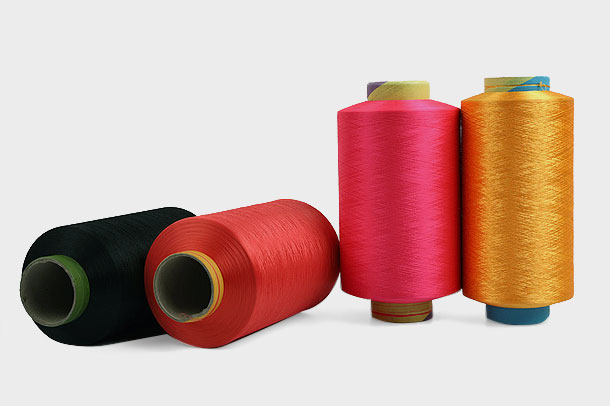
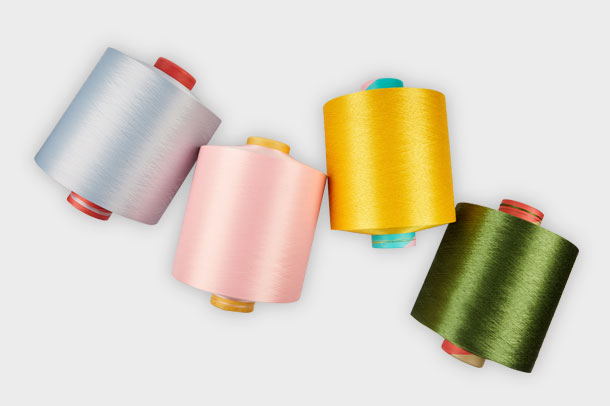
In dope-dyed polyester colored yarn, shade is set inside the filament at extrusion, so batch-to-batch consistency depends on pigment strength control and spin-line stability rather than on dye-bath chemistry.
That is the structural reason a spin-dyed lot holds color across a long campaign. Package dyeing asks the fiber to take up dye from a bath, and every variation in draw orientation, crystallinity or package density turns into a difference in dye uptake, which is the mechanism behind barré. Dope dyeing removes dye uptake from the equation and leaves three inputs to control.
Geometry explains a failure that catches buyers off guard. 150D/48F runs at 3.1 dpf and 150D/36F at 4.2 dpf; at an identical pigment load the finer filament carries more surface area per gram and reads lighter and brighter. Change the filament count mid-order and the shade moves even though the recipe did not.
Shade drift in a long colored yarn run traces back to six controllable points, and four of them sit upstream of the winding head.
| Process stage | What drifts | What the knitter sees | Control that holds the lot |
| Masterbatch intake | Pigment lot strength, particle dispersion | A whole campaign reading one step lighter or duller | Drawdown test on every incoming lot against a retained standard |
| Melt dosing | Feeder calibration, chip moisture | Slow creep over hours rather than a step change | Gravimetric dosing with an hourly ratio check against the recipe |
| Spinneret pack | Filtration pressure rise, partial hole blockage | Fine streaks and barré that only show after knitting | Pressure alarms plus a fixed pack change interval |
| Quench air | Velocity and temperature drift across the blowing cell | Side-to-side variation inside one package | Calibrated quench cabinet with daily logged readings |
| Draw and texturing | Draw ratio, heater temperature, D/Y ratio | A step that was invisible on the flat yarn | Locked process recipe per lot and first-off approval before the campaign |
| Winding and finish | Oil pick-up, package density | Patchy appearance and an uneven hand | Finish metering control with tension monitoring |
A flat yarn approved on the spin line can still shift once it passes through texturing, because heat history changes bulk and cover, and the same input yarn run at a different heater temperature lands a visible step away. Approve the textured form separately, on a knitted sock, and keep the texturing recipe attached to the lot record. Buyers auditing a supplier can request the process data behind each of the six stages and review the manufacturing route itself instead of judging from a shade card.
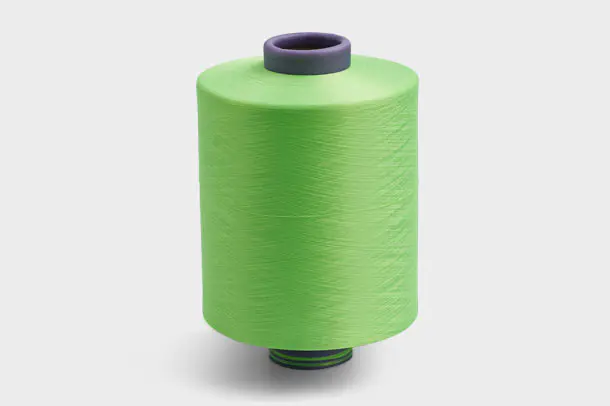 Polyester DTY Yarns for Textured Filament ApplicationsReview this false-twist draw-textured polyester series for denier, luster, twist and recycled options when specifying textured yarn lots.View Product →
A colored yarn program needs four numbers written down before spinning starts, because a verbal shade approval cannot be audited three months later.
Measurement discipline carries as much weight as the limit. ISO 105-J03 sets out how color difference is calculated instrumentally, and the reading should come from a wound card or knitted sock prepared the same way for every lot, conditioned, then measured at least three times with the average reported. A visual check in a light booth under D65 and TL84 catches metamerism that a single-illuminant number hides, which matters when a pigment-colored yarn is paired with a dyed trim or lining. Zhejiang Hengyuan Chemical Fiber Group Co., Ltd., a polyester filament and colored yarn manufacturer operating in Xiaoshan, Hangzhou since 2006, lists its FDY, DTY and POY ranges as separate series, which makes it straightforward to lock one geometry and one polymer route into a specification.
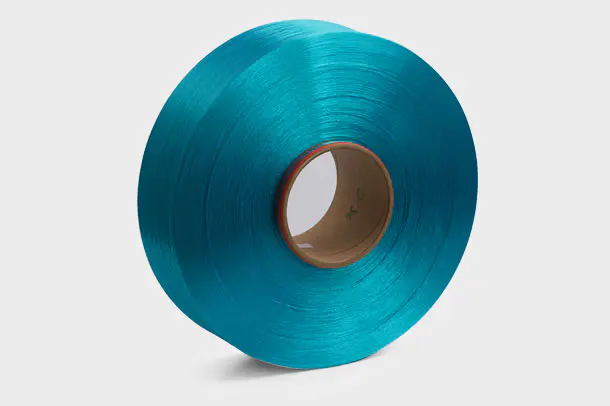 Polyester FDY Yarn Series for Weaving and KnittingCheck this fully drawn flat polyester series for denier, luster, recycled and high-tenacity options when defining a yarn specification.View Product →
On an order larger than one spinning campaign can deliver, supply planning protects the shade more effectively than tightening the Delta E limit, because the seam between campaigns is where a program breaks.
Traceability is what makes the difference auditable. Every carton should carry the lot number, denier and filament count, masterbatch lot and campaign date, and the buyer should hold a knitted sock from each lot. Do not mix two lots inside one cut-and-sew panel; the join can appear after the first wash even when both lots pass the tolerance individually. If an order will run to several campaigns, book the tonnage allocation in writing and keep the balance of an earlier lot in stock rather than switching sources mid-panel.
A colored yarn specification that names the color difference limit, the illuminants, the filament geometry and the masterbatch traceability closes the gaps that a shade card leaves open.
Buyers comparing suppliers can work through the color matching questions in this guide to choosing polyester color yarn before the first sample is requested, because the answers reveal whether the mill controls shade at the spinneret or only inspects it at the packing line.
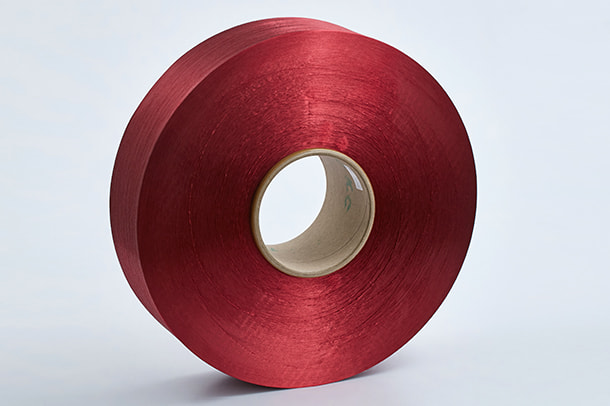 Polyester POY Feed Yarn for DTY and FDYReview this partially oriented feed yarn for draw-texturing and FDY production, including cationic dyeable grades for differential dyeing and recycled POY.View Product →
A Delta E CMC(2:1) of 1.0 or less under D65 at 10 degrees is the working gate for solid shades, confirmed by a grey scale rating of 4-5 or better under ISO 105-A02. Pastel shades need the tighter end of that range, because a one-unit step is proportionally larger against a pale ground than against a deep navy.
Yes, and the process should be planned rather than improvised. The colorant supplier standardizes each lot to a target strength, the converter runs a drawdown against a retained standard, adjusts the let-down ratio if needed, and submits the new lot for approval before the campaign starts. Allow one re-approval cycle in the schedule instead of assuming zero drift.
It does. 150D/48F runs at 3.1 dpf and 150D/36F at 4.2 dpf, so at the same pigment load the finer filament presents more surface area and reads lighter and brighter. Filament count and cross-section belong in the specification, not in a side conversation between technicians.
That depends on denier and line configuration, so the supplier should quote the maximum single-campaign tonnage for the exact denier ordered and the lead time for a second campaign. With both figures a buyer can decide whether to hold one lot in stock or accept a documented campaign change with a fresh first-off approval.

Zhejiang Hengyuan Chemical Fiber Group Co.,Ltd. is a professional China polyester filament yarns manufacturers and polyester color yarn suppliers, Established in 2006 ,located in YaQianTown Xiaoshan Hangzhou – One of the Center of polyester yarn Industry in China.

Products
Contact info
Copyright © Zhejiang Hengyuan Chemical Fiber Group Co.,Ltd. All rights reserved