Add: NYaqian Road No128 Yaqian Town Xiaoshan Hangzhou Zhe Jiang China.
Tel: 0086-0571-82602080
Fax: 0086-0571- 82758132
E-mail: [email protected]
Article Directory
A two-ply 1,200 denier bulked continuous filament polyester carpet yarn can pass a lightfastness test, tuft cleanly at 1/8 gauge, and still mat flat in a hotel corridor within eighteen months. The polymer is rarely the reason. The reason is a specification gap: the yarn was bought on denier and price per kilogram, and the three properties that decide how a carpet wears were never written into the order.
Bulkiness decides how much floor one kilogram covers and how fast the pile springs back after a footstep. Abrasion resistance decides how much face fibre is lost before the pattern goes dull. Colorfastness decides whether the shade approved in the sample room still matches the roll received in month six. Each property needs its own specimen, its own test and its own line on the purchase order.
Bulk is a volume and recovery property. Abrasion resistance is a pile and construction property. Colorfastness is a dye-chemistry property. A supplier who answers all three with "1,200 denier" has answered none of them.
Bulkiness is the specific volume a yarn occupies per unit of weight, and it is quantified through crimp contraction, crimp modulus and crimp stability rather than total denier. Two yarns of identical 2,400 denier total can sit at different bulk levels and produce visibly different pile height at the same tufting weight.
Bulk comes from the texturing route, not from the spinneret alone. Stuffer-box crimping with saturated steam, the standard route for bulked continuous filament, forces the filament bundle into a three-dimensional helix that is then heat-set to hold the shape. False-twist texturing produces a tighter helix with different recovery behaviour. The two routes are not interchangeable on a carpet line, and a specification that names only "textured polyester" leaves the choice to the supplier.
Bulk also has to survive the process: tufting-needle penetration, dyeing or finishing heat, and the first months of foot traffic. A yarn that shows high crimp on the cone but collapses in the dyebath is a bulk figure that never reaches the floor.
Crimp contraction is the percentage of length a yarn recovers after a defined load is applied and released, measured after a fixed dwell time. Crimp modulus repeats the measurement at a lower load and expresses springiness under light compression. Crimp stability measures how much of that recovery survives steam or boiling water.
| Parameter | Reference method | Specification line to request |
| Total denier and ply | ISO 2060 linear density check on cones | Nominal figure with a tolerance, for example 2,400 denier two-ply plus or minus 2% |
| Crimp contraction | Load-and-recovery crimp test with the load and dwell stated | Minimum percentage, with test load, dwell time and heat treatment printed beside it |
| Crimp modulus | Same test at a reduced load | Minimum percentage, used to judge springiness under light compression |
| Crimp stability | Steam or boiling-water treatment followed by recovery measurement | Maximum permitted loss of bulk after the stated treatment |
| Hot-water shrinkage | ASTM D2259 | Upper limit in percent at a stated water temperature |
| Spin finish | Extraction or the supplier's stated method | A range in percent, not a single target value |
A crimp figure without its test conditions is marketing, not data. Ask both suppliers for the load, the dwell time and the heat treatment before any comparison is made. If the commercial team uses "bulky" as a selling word rather than a measurement, this explanation of what bulked polyester yarn actually is helps separate the two.
Polyester's intrinsic abrasion behaviour is rarely the limiting factor in a residential carpet; pile density, twist level and heat-set quality decide how long the face survives foot traffic. A wear claim built on fibre type alone tells a buyer nothing about the fourth year of service.
Filament size sets the balance between softness and spring. Coarse filaments, in the range commonly quoted as 10 to 25 denier per filament for residential carpet BCF, resist bending fatigue and give the pile its recovery; finer filaments feel softer but pack down sooner under the same traffic. Twist is the second lever. A tightly twisted two-ply holds tip definition through vacuuming, and heat setting locks that twist so it does not unwind in the dyebath. The right crimp with the wrong twist set still crushes at the top of a staircase.
Where a programme needs a softer, finer face than stuffer-box BCF allows, false-twist textured yarn is the alternative route, and it is specified on tenacity and crimp stability rather than on bulk alone.
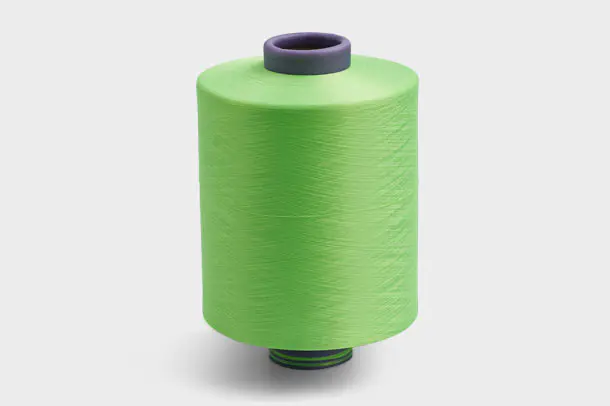 False-Twist Textured Polyester DTY YarnsFalse-twist textured polyester filament yarn offering soft hand, bulk and crimp stability, an alternative to coarser BCF where a finer face is needed.View Product →
Colorfastness is not one property. Light, rubbing and wet cleaning are tested on different specimens with different equipment, and a yarn can pass one while failing another by two full grades. Polyester has no reactive dye sites, so package-dyed polyester runs on disperse dyes that sit inside the filament and can migrate under later heat; solution-dyed polyester carries pigment dispersed in the polymer before extrusion. That difference in dye chemistry is the first thing to establish before any certificate is quoted.
| Fastness property | Method | Commercial target to request |
| Lightfastness | AATCC TM16.3 Option 3 xenon arc, or ISO 105-B02 | Grade 4 minimum, with the AFU exposure stated on the certificate |
| Dry crocking | AATCC TM8 or ISO 105-X12 | Grade 4-5 minimum |
| Wet crocking | AATCC TM107 | Grade 4 minimum |
| Water immersion | AATCC TM162 | Grade 4-5, including staining of the adjacent multifibre strip |
| Laundering, for mats and blankets | AATCC TM61 or ISO 105-C06 | Grade 4 after the stated number of cycles |
| Bleach spot, where specified | Sodium hypochlorite spot test under the buyer's cleaning regime | Grade 4, or a written exclusion from the warranty |
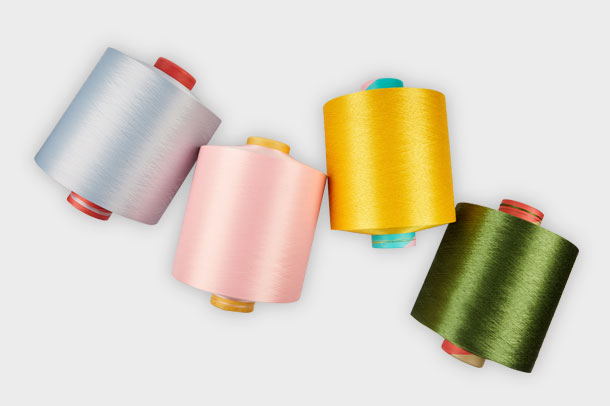
Solution-dyed polyester generally holds lightfastness and bleach resistance better and removes dye-lot variation from the tufting line. Package dyeing keeps minimum order quantities lower and shade matching faster, at the cost of a dye that can migrate during backing or heat-setting steps. Specify by programme: solution-dyed where bleach and sunlight exposure are severe, package-dyed where a wide shade card and short runs drive the order book.
Shade approval on a lab dip proves nothing about the sixth container. Write a colour tolerance in delta E terms, measured on tufted pile rather than on yarn, under a stated illuminant such as D65, and check a second illuminant for metamerism. A tolerance of delta E 1.0 or tighter under CIEDE2000 is a workable commercial line for adjacent lots; anything wider shows as a seam where two dye lots meet.
Four checkpoints separate a specification from a shipment: a document screen, a laboratory sample, a pile-level trial and a pre-shipment lot hold. Skipping the third is the most expensive shortcut in carpet yarn buying, because crimp loss and shade shift both surface on the tufted face, not on the cone.
Request a technical data sheet carrying crimp contraction with its test conditions, hot-water shrinkage, tenacity to ISO 2062, the spin finish range and lightfastness quoted with both AFU value and grade. Reject any sheet that lists denier alone.
Ask for 2 kg to 5 kg of production-representative cones rather than a hand-built pilot lot, then re-measure denier, crimp and shrinkage on your own bench against the sheet.
Tuft or knit at least 1 square metre at the intended pile height, density and stitch rate. Test appearance change, crocking and lightfastness on the face; that sample size is enough to expose bulk loss and shade shift.
Measure delta E against the approved standard, check crimp variation across cones from the same lot, and keep a retained sample from the actual shipment in the warranty file.
The supplier side matters as much as the test plan. Zhejiang Hengyuan Chemical Fiber Group Co., Ltd. has manufactured polyester filament and coloured yarn in Xiaoshan, Hangzhou since 2006, and lists carpet and rug yarn as a dedicated series alongside drawn textured and fully drawn filament.
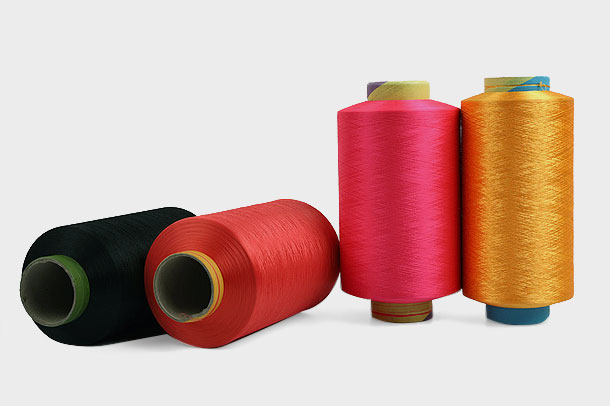
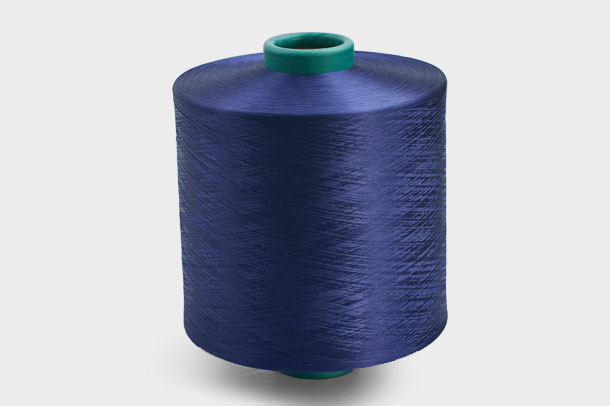 Polyester BCF and Spun Carpet YarnBCF and spun polyester carpet yarns for tufted and hand-tufted rugs, with bulk, abrasion resistance and solution-dyed options relevant to carpet cost and shade consistency.View Product →
Bulk, abrasion life and shade rework move landed cost per square metre, and each traces back to a specification line. A yarn that yields more cover per kilogram at the same pile weight cuts yarn consumption across the whole order; a lot that fails the delta E check at pre-shipment produces a re-dye, a re-sort or a concession. Both costs land on the buyer, not on the invoice price.
Conditioned weight matters too. Polyester's moisture regain of roughly 0.4% at 20 C and 65% relative humidity keeps invoiced weight close to dry weight, so price comparisons hold across seasons and shipping routes. Compare offers on conditioned weight at a stated regain rather than on shipping weight, and put that regain figure in the contract.
Tuft two samples at identical pile height, density and stitch rate, then weigh the pile yarn per square metre. The difference in yarn mass at equal pile height is the cover difference, and it converts directly into a yarn consumption figure for the full order. Crimp figures from two suppliers can only be compared when test load, dwell time and heat treatment are identical.
Lightfastness, quoted with the exposure in AFU and the grade on the same line, because a grade without an exposure value is not a specification. Follow it with wet crocking to AATCC TM107, the failure mode that spot cleaning and spill treatment reach first, and with hot-water shrinkage to ASTM D2259 for any programme where the yarn meets a dyebath.
No. Solution-dyed polyester wins on lightfastness, bleach resistance and lot-to-lot consistency, but it carries higher minimum order quantities and a slower shade development path. Specify it where sunlight, chlorine bleach or commercial cleaning dominate; specify package-dyed yarn where a wide shade card and short runs matter more than bleach fastness.
Delta E 1.0 or tighter under CIEDE2000, measured on tufted pile under D65, is a workable commercial line for adjacent lots; wider tolerances appear as a seam where dye lots meet. Add a second illuminant check for metamerism, and keep a retained sample from each lot in the warranty file.

Zhejiang Hengyuan Chemical Fiber Group Co.,Ltd. is a professional China polyester filament yarns manufacturers and polyester color yarn suppliers, Established in 2006 ,located in YaQianTown Xiaoshan Hangzhou – One of the Center of polyester yarn Industry in China.

Products
Contact info
Copyright © Zhejiang Hengyuan Chemical Fiber Group Co.,Ltd. All rights reserved