Add: NYaqian Road No128 Yaqian Town Xiaoshan Hangzhou Zhe Jiang China.
Tel: 0086-0571-82602080
Fax: 0086-0571- 82758132
E-mail: [email protected]
Article Directory
A hospital privacy curtain is expected to pass NFPA 701 flame propagation and still hold an antibacterial claim after 50 home launderings. Standard polyester does neither, which is why the yarn written into that specification is never standard polyester.
Functional polyester yarns move the active chemistry into the polymer chain or into the melt, so the performance belongs to the fiber instead of a surface treatment that washes away. For a buyer, the real question is narrower than the marketing language suggests: which additive route, at what loading, verified against which test method, and how much of it is left after finishing, dyeing and laundering.
This guide covers the two performance families, the chemistry behind each one, the process limits that decide which routes are even manufacturable on a polyester line, and the clauses that belong in a purchase order.
A functional polyester yarn is a polyethylene terephthalate (PET) filament that carries a defined additive or comonomer at a controlled loading, so the finished yarn delivers a measurable property such as a log reduction or a flame spread result that standard PET cannot deliver.
Functional polyester yarn: PET filament in which an antibacterial, flame-retardant, UV-stabilising or antistatic agent is introduced during polymerisation, masterbatch compounding or melt spinning, and whose performance is verified against a published test standard rather than a visual claim.
Three manufacturing routes exist, and they differ far more in durability than in unit price:
Denier frames the application. Healthcare and apparel programs usually sit between 50D/24F and 300D/96F, while flooring uses bulk continuous filament (BCF) in the 1000 to 2600 dtex range, where flame and antimicrobial behaviour is judged on the finished carpet rather than on the yarn alone.
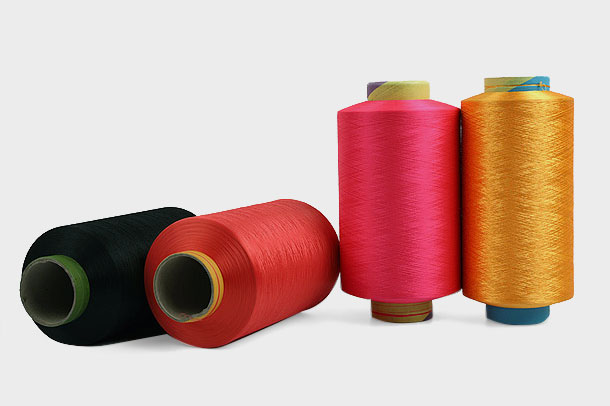
 Functional Yarn ManufacturersPerformance Integration at the Yarn Stage: Functional properties engineered into the yarn — through polymer modification, fiber cross-section design, or additive incor...View Product →
Antibacterial performance on polyester is reported as a log reduction, and a commercial claim normally needs at least a 2-log (99 percent) reduction under ISO 20743, or 99.9 percent under AATCC 100, still present after repeated laundering.
| Active system | Mode of action | Route and loading | Watch-out |
| Silver ion on zeolite or glass carrier | Binds thiol groups in bacterial enzymes and interrupts DNA replication | Masterbatch in the melt, 0.3 to 1.5 percent by weight | Yellowing risk in bright whites, biocidal product review in the EU |
| Zinc pyrithione | Disrupts membrane transport and enzyme activity | Masterbatch or pad finish, 0.1 to 0.5 percent | Strong on flooring textiles, use restrictions inside the EU |
| Quaternary ammonium silane | Physically ruptures the cell membrane and stays bound to the fiber | Copolymer or exhaust finish | Low migration and durable, but a narrower spectrum than silver |
| Chitosan | Cationic biopolymer attacks the cell wall | Exhaust finish or blend, 1 to 3 percent | Bio-based, but loses activity fastest in alkaline laundering |
The test method decides whether a claim is defensible. ISO 20743 is the quantitative method most European buyers accept, AATCC 100 is the standard reference in the United States, and AATCC 147 is only a qualitative parallel streak test that cannot support a percentage claim on its own.
Durability is where suppliers separate from each other. A protocol such as AATCC 135, run for 50 home laundering cycles, is the working benchmark for healthcare and hospitality textiles. Yarns with the active dispersed inside the filament typically lose 0.3 to 0.6 log across 50 cycles, whereas a surface-applied finish commonly falls below 1 log within 20 cycles.
Rule of thumb for purchase orders: specify the standard, the log threshold and the laundering protocol together. An antibacterial claim without a wash cycle number is not a specification.
Regulation closes the loop. Inside the European Union, treated articles fall under the Biocidal Products Regulation (EU) No 528/2012, triclosan is not an option, and silver-based actives remain under active evaluation. Any supplier shipping an antibacterial textile into the EU has to document both the active substance and its approval status. The same pressure applies in healthcare, where textile buyers increasingly treat the antimicrobial claim as part of the infection-control file, as covered in this note on antibacterial functional yarn for medical use.
Flame-retardant polyester works either in the condensed phase, where phosphorus promotes char formation and starves the flame of fuel, or in the gas phase, where halogen chemistry scavenges the radicals that carry combustion. The choice is not a matter of preference; it is set by the 280 to 295 degrees Celsius window of the PET melt spinning line.
A phosphorus comonomer is built into the PET backbone at roughly 0.5 to 1.0 percent phosphorus by weight. The result is permanent: it survives dyeing, repeated laundering and abrasion. Limiting oxygen index (LOI) reaches 30 to 32 against 20 to 21 for standard PET. The cost is a dedicated polycondensation line and a higher polymer price.
The flame retardant is compounded into carrier chips and let down in the spinning line. Changeovers are fast and the capital cost is low, but the loading itself costs tenacity, and mineral systems need 40 to 60 percent loading to work at all, a level no textile filament survives.
The temperature limit rules out most mineral chemistry. Aluminium trioxide hydrate releases its water endothermically at 180 to 220 degrees Celsius, so it cannot pass through a PET melt and belongs in a back-coating instead. Magnesium hydroxide decomposes near 330 degrees Celsius, which leaves almost no margin in a 290 degree spinning line. Halogen plus antimony trioxide delivers a high LOI in the melt, but decaBDE was listed under the Stockholm Convention in 2017 and halogen-free programs are now the default in European contract textiles.
| FR system | How it works | Processing limit | Typical LOI |
| Copolymerised phosphorus | Char formation in the condensed phase | Added during polycondensation, stable above 290 C | 30 to 32 |
| Halogen with antimony trioxide | Gas-phase radical scavenging | Masterbatch, stable in the melt | 28 to 33 |
| Phosphorus masterbatch | Condensed-phase char, let down 1:10 to 1:20 | Masterbatch, stable in the melt | 26 to 29 |
| Aluminium trioxide hydrate | Endothermic water release dilutes the fuel | Decomposes at 180 to 220 C, coating only | 24 to 27 on coated fabric |
| Magnesium hydroxide | Endothermic release at higher temperature | Decomposes near 330 C, marginal in the melt | 25 to 28 at high loading |
Limiting oxygen index by fiber, percent oxygen required to sustain combustion
Values are typical LOI ranges measured by ASTM D2863 or ISO 4589-2. A fiber must exceed the oxygen concentration of its environment to self-extinguish.
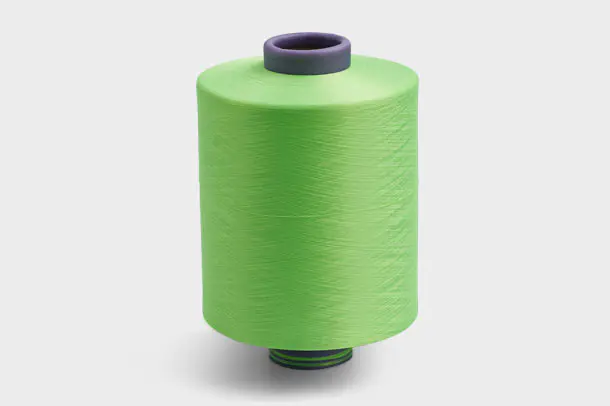 Polyester DTY Yarns SuppliersProduct Specifications Technical ParametersView Product →
Yes, antibacterial and flame-retardant performance can be built into a single polyester yarn, but the additive package has to be selected as a pair rather than as two independent purchases, because several actives interfere with each other chemically and thermally.
Three interactions decide whether a dual claim survives:
Test order matters as much as chemistry. The antibacterial result must be measured after the complete dyeing and finishing sequence, and the flame result must be measured after any back-coating is applied, because a finish added later can both occlude silver sites and add fuel to the fabric. A supplier who reports a flame test on greige fabric and an antibacterial test on finished fabric has measured two different products.
The combined antibacterial and flame-retardant specification pays for itself in five textile categories, each of which is governed by a national test method that forces both properties onto the same fabric.
| End use | Governing test | Typical yarn specification |
| Hospital privacy curtains | NFPA 701, ISO 20743 | 150D to 300D DTY, phosphorus FR plus silver masterbatch |
| Mattress ticking | 16 CFR 1632, AATCC 100 | 200D to 300D FDY or DTY, copolymerised FR |
| Upholstered seating | California TB 117-2013, ASTM E648 | 300D to 600D DTY, halogen-free FR |
| Contract carpet and rugs | 16 CFR 1630 and 1631, ASTM D2859 pill test | 1000 to 2600 dtex BCF, FR plus antimicrobial |
| Protective workwear | EN ISO 11612, NFPA 2112 | 150D to 300D FR filament, often blended with FR viscose |
Flooring is the category where the two functions reinforce each other most directly. A carpet face fiber carries both the antimicrobial requirement, driven by moisture and soil retention, and the flammability requirement, driven by the methenamine pill test in the United States and by ISO 9239-1 radiant flux testing in Europe. Because the surface area is large and cleaning cycles are aggressive, only yarns with the chemistry inside the filament hold their rating across the service life of the carpet.
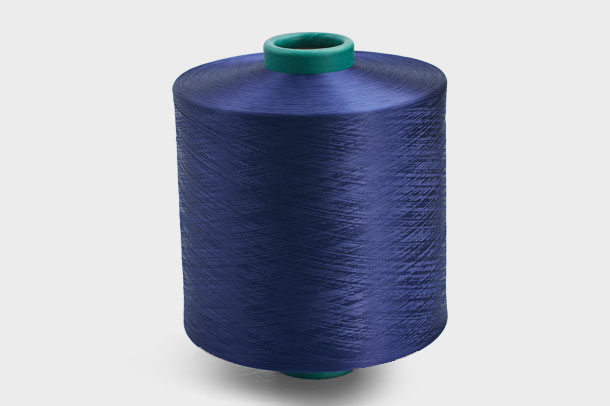 Polyester Carpet and Rug yarns Manufacturerscarpet yarns and rug yarnsView Product →
A functional yarn purchase order should name the test method, the pass threshold, the sample conditioning and the laundering protocol, because a bare antibacterial or flame-retardant label carries no technical content at all.
Zhejiang Hengyuan Chemical Fiber Group Co., Ltd. runs its manufacturing and product development under one roof, and buyers evaluating a functional grade can request the trial data and specification sheets through the company research and development centre before committing to a bulk order.
With silver-based yarns where the active sits inside the filament, ISO 20743 results after 50 AATCC 135 cycles typically drop by 0.3 to 0.6 log. A yarn that starts at 3.0 log reduction therefore stays above the 2-log claim threshold. A surface-finished fabric commonly falls below 1 log within 20 cycles.
It can, provided the silver is introduced at a loading below roughly 1 percent and the polymer is stabilized against thermo-oxidative degradation. Above that level, yellowing becomes visible in white shades and filament breaks rise on the spinning line. The flame result must then be re-tested on the finished fabric, not on the greige yarn.
Copolymerised phosphorus. Because the phosphorus is a comonomer inside the PET chain, it does not migrate, leach or wash out, and an LOI of 30 to 32 remains after 50 launderings. Additive masterbatch is the second choice, and back-coating is the least durable option, typically losing its rating first at flex and abrasion points.
150D to 300D textured yarn at 36 to 96 filaments per yarn gives the opacity, drape and dimensional stability a privacy curtain needs while staying light enough for standard track systems. Below 100D the fabric becomes too translucent for patient privacy, and above 400D the drape stiffens noticeably.
Antibacterial and flame-retardant performance in polyester is a chemistry decision long before it becomes a price negotiation. A 0.5 to 1.0 percent phosphorus copolymer delivers an LOI of 30 to 32 that no finish can match, and a silver system dispersed in the filament holds a 2-log ISO 20743 claim through 50 laundering cycles, while the same claim applied as a coating is gone within 20. Specify the standard, the threshold and the wash protocol on the purchase order, request test data from the finished fabric, and the two properties stop competing with each other.
Hot Products

Zhejiang Hengyuan Chemical Fiber Group Co.,Ltd. is a professional China polyester filament yarns manufacturers and polyester color yarn suppliers, Established in 2006 ,located in YaQianTown Xiaoshan Hangzhou – One of the Center of polyester yarn Industry in China.

Products
Contact info
Copyright © Zhejiang Hengyuan Chemical Fiber Group Co.,Ltd. All rights reserved