Add: NYaqian Road No128 Yaqian Town Xiaoshan Hangzhou Zhe Jiang China.
Tel: 0086-0571-82602080
Fax: 0086-0571- 82758132
E-mail: [email protected]
Article Directory
When you are sourcing yarn for weaving, knitting, or tufting, one of the first questions a supplier will ask is whether you need continuous filament or a staple-spun product. That question matters more than any single spec sheet value, because the physical form of the yarn determines how it behaves across every downstream process, from warping to dyeing to final fabric wear.
Here is the direct answer: fully drawn yarn (FDY) is a continuous multifilament yarn produced by melt spinning and drawing polyester in one uninterrupted process. Spun yarn, in contrast, is made by cutting or breaking filaments into short staple fibers and then twisting those fibers together into a cohesive strand. That structural difference is the root cause of nearly every performance gap between the two: strength, uniformity, surface texture, pilling tendency, dye response, and cost. You cannot compensate for it later with finishing chemicals or process tweaks, so the choice has to be made at the specification stage.
This guide compares the two yarn families from the perspective of a textile manufacturer and buyer, examining what each one delivers in real production conditions, not just on paper.
Fully drawn yarn, commonly known as FDY, is produced by extruding polyethylene terephthalate (PET) melt through spinneret holes and then drawing the solidified filaments to several times their original length. This drawing step orients the polymer molecules along the fiber axis and builds the crystal structure that gives FDY its distinctive tensile profile.
Because the drawing and heat-setting take place during manufacturing, the yarn arrives at your mill in a dimensionally stable state. Shrinkage is already low, the denier per filament is consistent along the entire package, and there are no protruding fiber ends on the surface. In the industry, FDY is usually described as a flat yarn: smooth, regular, and uniform. Typical fully drawn polyester yarn has a tenacity of 3.5 to 4.5 cN/dtex before weaving, which is significantly higher than most staple-spun equivalents of similar linear density. The same material characteristics explain why FDY is the default choice for applications that demand predictable tension, uniform dye take-up, and high weaving or knitting efficiency.
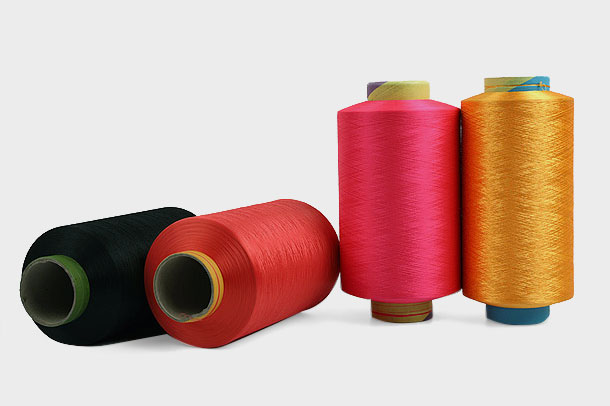
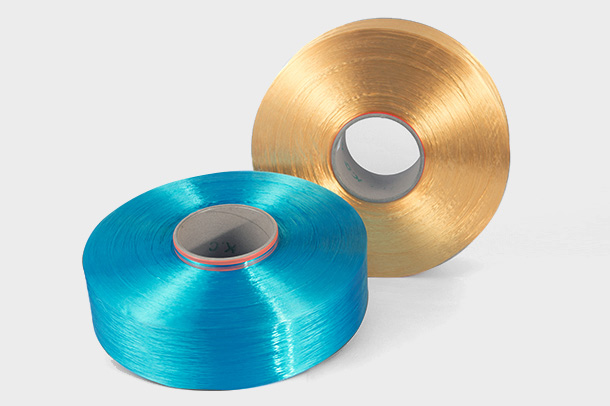
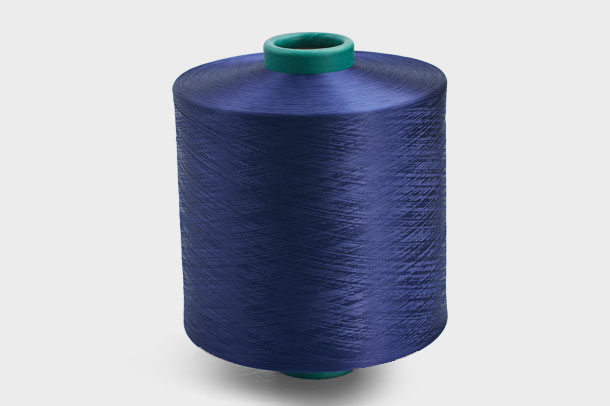
If you are sourcing continuous filament yarn, the polyester FDY series covers common semi-dull and bright specifications across the typical apparel and home textile denier range.
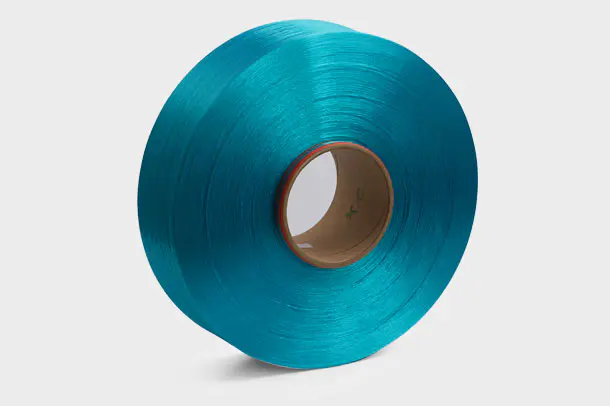 China Wholesale Polyester FDY Yarns Manufacturers, FactoryAs a China polyester FDY Yarns manufacturers and polyester FDY factory, Zhejiang Hengyuan Chemical Fiber Group Co.,Ltd. provide wholesale...View Product →
Spun yarn starts from the same PET polymer, but the production route is fundamentally different. The polymer is first formed into staple fibers of a defined cut length, usually 38 mm for cotton-system spinning or longer for woolen and worsted systems. Those fibers then pass through opening, carding, drawing, and roving stages before being twisted on a spinning frame, most commonly ring spinning, rotor spinning, or air-jet spinning.
The twisting operation is what gives spun yarn its cohesion. Individual fibers interlock around each other, trapping air between them and creating a hairy, uneven, but very textile-like surface. This is why spun polyester is often chosen when fabric designers want a cotton-like or wool-like hand feel. But the same fiber ends also create liabilities: lower tensile strength per unit mass, higher elongation at break due to inter-fiber slippage, more variation in linear density, and visible surface fuzz that worsens with abrasion.
To understand where the two raw material families diverge in supply chain structure, it helps to look at how polyester filament and staple fiber differ as raw materials before they reach the spinning mill.
The table below condenses the most relevant differences for a purchasing or production decision. These values represent typical commercial-grade polyester materials rather than specialized variants.
| Property | Fully Drawn Yarn (FDY) | Spun Yarn (100% Polyester Staple) |
|---|---|---|
| Physical structure | Continuous multifilament, no fiber ends | Short staple fibers twisted together |
| Typical tenacity | 3.5–4.5 cN/dtex | 1.5–2.5 cN/dtex at comparable count |
| Evenness | Very high, CV% typically below 1.5 | Moderate; unevenness depends on spinning system |
| Surface character | Smooth, clean, low friction | Hairy with protruding fiber ends |
| Pilling resistance | High, fibers cannot be pulled loose | Lower; fiber ends abrade and tangle into pills |
| Dyeing behavior | Uniform uptake, fewer shade bars | More variable; requires fiber-level dye-batch discipline |
| Moisture feel | Often described as slimy or plastic-like | Drier, more cotton-like hand feel |
| Yield and waste | Lower processing waste | Higher waste from fiber fly and breakages |
| Typical use cases | Woven linings, taffeta, parachute fabric, ribbons, narrow fabrics | Knitted wear, towels, blankets, casual apparel fabrics |
One point deserves emphasis: the strength gap does not mean spun yarn is inferior. It means the two products serve different mechanical requirements. A high-tenacity spun yarn will still be weaker than a standard FDY at the same count because the failure mode in spun yarn involves fiber pullout, while failure in FDY requires breaking polymer chains.
Woven fabrics made from FDY carry a dual advantage: the component filaments are stronger to begin with, and the lack of twist means all filaments work in parallel rather than at an angle to the yarn axis. That parallel alignment gives FDY fabrics their crisp, rigid drape and high tensile resistance. Spun yarns, by contrast, sacrifice a portion of their theoretical strength because twist places fibers at an incline to the yarn axis, and under tension the weakest fibers break before the full bundle is loaded.
For applications where seam slippage, tear strength, or strap breaking load is critical, FDY is the reliable answer. Buyers who source FDY for demanding technical fabrics should review tenacity and elongation quality control for FDY yarns before setting incoming inspection limits.
Pilling is the clearest visible difference. In a spun yarn, fiber ends protrude from the surface. When the fabric rubs against another surface, those ends are pulled outward, tangle into balls, and eventually anchor to the fabric by a few remaining fibers. This is the classic pilling mechanism. FDY cannot pill in the same way because there are no free fiber ends. Surface wear in an FDY fabric will produce fuzzing or, in severe cases, filament breakage, but it will not form the same anchored pills. This makes FDY the logical choice for upholstery, car seat fabrics, luggage, and other high-abrasion uses where appearance retention matters.
Color uniformity is where FDY has a systematic advantage. Because the filament is continuous and extruded from a single polymer melt, dye uptake along the yarn axis is very consistent. Even minor denier variations in FDY can still cause slight shade differences, which is why premium FDY suppliers control denier tolerance to under 1%. But the variation across a spun yarn is inherently larger because each package contains millions of individual fibers that may have originated from different tow lots or polymer batches.
From a buyer's planning perspective, this matters for two reasons. First, shade matching: an FDY-based fabric will achieve batch-to-batch consistency with less effort, which shortens lead time in the dyehouse. Second, production yield: shade bars in knitted and woven goods are a leading cause of off-grade inventory, and they are far harder to eliminate in staple-spun materials.
On the cost side, spun yarn is usually cheaper per kilogram in simple commodity counts, but the effective cost per finished meter can equalize once you account for higher waste, more frequent machine stops, and added pilling-control or anti-pilling finishing steps. A reliable way to estimate real cost is to compare the two candidate yarns in a pilot trial using your own loom or knitting machine settings, not just the quoted price per ton.
FDY packages run cleanly through warping and weaving. The low coefficient of friction and absence of fly mean fewer broken ends, cleaner warp beams, and less machine stoppage. Mills that target high-speed air-jet weaving efficiency usually standardize on FDY for warp and reserve spun yarn for weft where a softer hand is desired. Spun yarns, particularly ring-spun, shed staple fiber during high-tension processes, which contaminates the weaving environment, requires more frequent cleaning cycles, and weighs on loom efficiency.
For single- and double-knit fabrics, spun yarn delivers a softer, warmer surface that is closer to natural fibers. If the end product is a sweater, baby blanket, or casualwear fabric where the hand feel is the selling point, spun polyester is the expected choice. The same fabric construction made entirely from FDY will feel smooth and cool to the touch, with a slightly silkier luster. Before specifying, ask what the final consumer actually touches, not just what the tensile data shows.
Many commercial fabrics combine both yarn types. A typical woven structure uses FDY warp for strength, dimensional stability, and smoothness, while the weft is spun yarn for cover and texture. This hybrid approach is standard in outerwear linings, upholstery, and shirting. In that context, the comparison between FDY and spun yarn becomes a selection within a blend, not an either-or decision. Polyester DTY, a textured continuous filament made by false-twist processing of POY, is also a common middle option that gives some spun-like texture while preserving filament advantages; if you want to compare that route against spun yarn, the polyester DTY series is a relevant reference point.
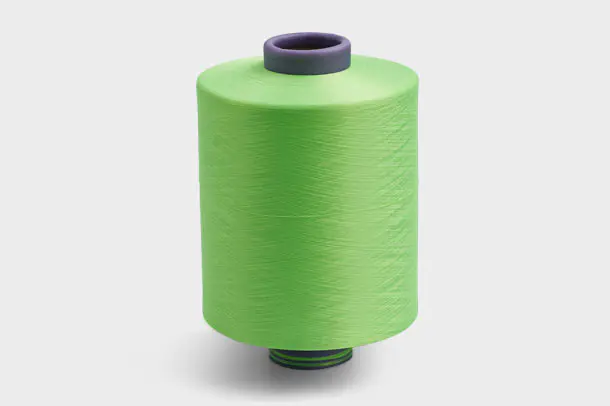 Wholesale Polyester DTY Yarns Suppliers, China DTY CompanyZhejiang Hengyuan Chemical Fiber Group Co.,Ltd is China polyester DTY yarns suppliers and polyester DTY company, you can find wholesale p...View Product →
Tufted carpets and rugs are a special category. Traditional tufting machines were developed around spun nylon and wool yarns, but modern polyester carpet yarns now use a twisted or heat-set continuous filament construction. This is not FDY in the flat form and not staple spun yarn; it is a hybrid called BCF (bulked continuous filament) or a twisted FDY-based construction. The surface performance, cleanability, and resilience of such yarns differ from both standard FDY fabrics and staple-spun carpets. Tufted flooring buyers should evaluate polyester carpet and rug yarn series against their pile-weight and wear-class requirements rather than assuming spun standards apply.
 Carpet Yarns Manufacturers, Wholesale Rug Mat Yarn SuppliersAs a leading China carpet yarns manufacturers and rug mat yarns suppliers, Hengyuan Chemical Fiber Group Co.,ltd provide wholesale polyes...View Product →
Use this short decision sequence whenever the choice comes up.
A reputable manufacturer will not push one type blindly. The right product depends on the loom type, the end market, and the quality claims the customer needs to make. For a full view of available filament options, inspect the entire polyester yarn product range as well.

Zhejiang Hengyuan Chemical Fiber Group Co.,Ltd. is a professional China polyester filament yarns manufacturers and polyester color yarn suppliers, Established in 2006 ,located in YaQianTown Xiaoshan Hangzhou – One of the Center of polyester yarn Industry in China.

Products
Contact info
Copyright © Zhejiang Hengyuan Chemical Fiber Group Co.,Ltd. All rights reserved